
Key takeaways
- SEO for ChatGPT aims to improve your visibility in ChatGPT's answers by earning mentions, citations and placements. You can also use ChatGPT itself to speed up SEO tasks.
- Ranking in ChatGPT builds on SEO fundamentals: you get there by improving your rankings on Bing, earning mentions on affiliate, news and aggregator sites, optimising your content structure and building credibility through E-E-A-T.
- Local businesses can improve their chances of appearing in ChatGPT by claiming and optimising their profiles on platforms such as Bing Places, Tripadvisor, Google Business Profile and Apple Maps.
- ChatGPT can support SEO workflows, including keyword research, meta tag writing, schema markup, content ideas and finding third-party sites for outreach.
- For most businesses, tracking rankings in ChatGPT is still a manual job.
With the rise of ChatGPT, you probably want to benefit from it as other businesses do. That means doing SEO for ChatGPT to help you rank in its answers, and also using the platform to improve your organic rankings.
We have split this page into two main sections: how to appear in ChatGPT, and how to use ChatGPT to rank (in the SERPs).
How to rank in ChatGPT
Here is how to get a good position in ChatGPT (through mentions and citations):
1. Follow SEO best practice
Search engine optimisation (SEO) is one of the most consistent traits of websites cited or mentioned in ChatGPT's answers. One study found that ChatGPT search results are 73% similar to Bing's search results.
Search engine optimisation lines up with most AI SEO best practice, which focuses on:
- Making the website accessible and crawlable so it can be "read" by search and answer engines
- Producing unique, authoritative, easy-to-read content
- Improving the online experience with readable, fast-loading pages
- Building a trustworthy profile through mentions, citations or backlinks on other sites.
Businesses that want to rank in ChatGPT should start with an SEO audit. From there, you can decide whether your search optimisation needs work before you turn to SEO for ChatGPT.
2. Improve your Bing rankings
Microsoft has invested $14 billion in OpenAI, the company behind ChatGPT, so it makes sense that ChatGPT's citations and Bing's top-ranking pages are correlated (as the study above shows).
Although Google and Bing use similar algorithms to generate results, the two are different. This is why omnichannel SEO strategies, which optimise content across several search platforms, matter more and more: they keep you visible whether users prefer traditional search engines or AI tools.
Just look at the results for the query "how to make slime" (DataForSEO, Google UK and Bing UK, September 2026):
On Google, BBC Good Food ranks first, below an AI Overview; on Bing, wikiHow ranks first and BBC Good Food only tenth. The results keep diverging from there: Google's page is packed with YouTube videos, short videos and image results, and only BBC Good Food and Home Science Tools make the top 10 on both search engines.
If you optimise for visibility on Bing rather than Google, bear in mind that those changes could affect your Google rankings and therefore your organic traffic (Google holds 78% of the search market, Bing 12%).
Here are some common steps to improve your Bing rankings:
- Set up Bing Webmaster Tools
- Claim a Bing Places listing (see our strategy on local listings below)
- Work on on-page, off-page and technical SEO.
You can find out more in our complete guide to SEO basics.
3. Get cited on affiliate, news and aggregator sites
People use answer engines like ChatGPT to get personalised recommendations, whether that is somewhere to eat on an upcoming holiday or the kitchen that best suits their cooking needs. These recommendations often use words like "best" or "top".
For businesses that want to be recommended, that means being featured on:
- Affiliate sites
- News sites
- Aggregator sites
Asking ChatGPT for the best sushi restaurants in London, its sources are (DataForSEO, ChatGPT UK, September 2026):
- Time Out
- The Infatuation
- Condé Nast Traveller
Some of these sites only require you to claim a local listing, while others take PR work. Discovery can happen organically or through outreach, for example by offering a free meal, a product sample or a tour of your service.
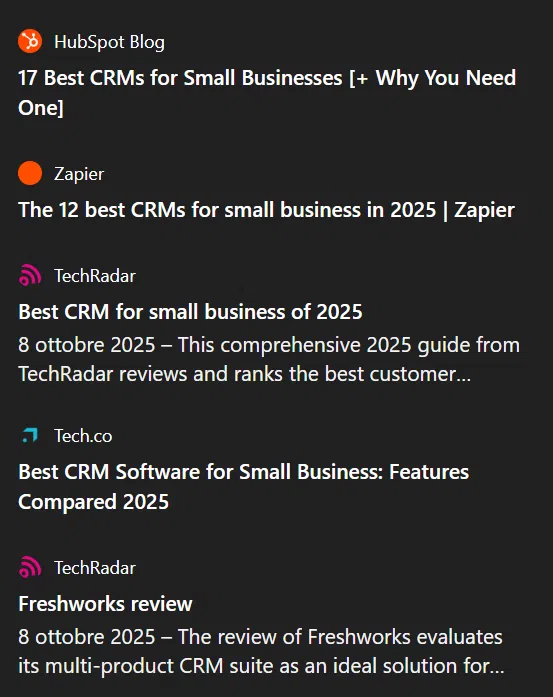
Note: non-local searches, such as looking for the best customer relationship management (CRM) platform for SMEs, rely less on local listings and more on well-known publishers. In this case, ChatGPT cites Zapier, HubSpot, TechRadar and Tech.co.
This tactic is much the same as traditional, basic SEO.
Businesses work on building their backlink profile through outreach, which is about offering the recipient something of value (such as an experience, a piece of content or a service) in return for consideration or a mention.
4. Optimise your content structure
As well as helping with traditional rankings (such as on Bing), an optimised content structure also works well in AI engines like ChatGPT. That is because headings, lists and tables make it easier to understand what a piece of content is for.
Combine that structure with easy readability and you are more likely to appear as a ChatGPT source. Take Scholastic.com's "Make Mad Scientist's Slime" page, which ChatGPT cites when asked for slime recipes.
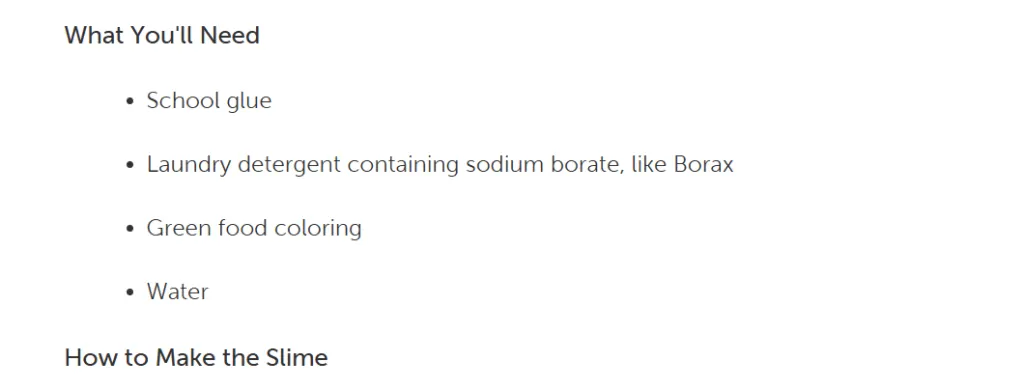
The page uses sections, like the one shown above, to organise the content:
- Slime ingredients
- Steps for making homemade slime.
Scholastic also uses bullet points to make specific sections easy to scan, such as the ingredients needed and the steps for making the slime, which shows the team understands online readers and its target market.
5. Strengthen content with E-E-A-T
Trust signals can also improve your position in ChatGPT:
- Certifications
- First-hand experience
- Citations
- Awards
- Author bios.
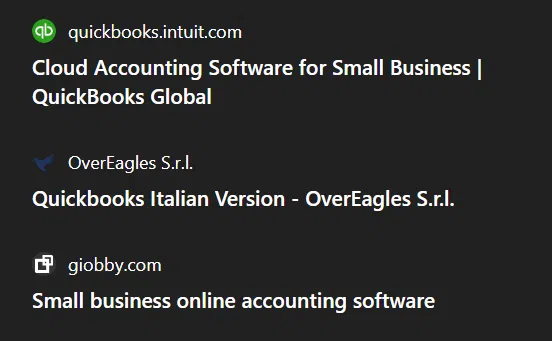
Remember, people use ChatGPT to get advice specific to their situation. They want more than the best accounting software for a small business: they want a reliable platform for a small home services business turning over £X a year.
Specific insight based on direct experience gives your content a competitive edge and beats AI-generated content, which is limited to its training data and the web data it can access.
6. Use visuals
In some cases, ChatGPT includes visuals (such as images, photos, charts or videos) in its answers, as here:

Creating your own visuals for relevant content, whether a photo, a graphic or a video, can get your business mentioned in ChatGPT's answers (and helps you counter zero-click searches). In the example above, when we ask for visual references and ideas for inspiration, ChatGPT cites websites such as Pinterest, YouTube and others that have invested in visual media.

You can use AI to generate all kinds of media, but consider whether it fits what the user is looking for. For example, someone searching for flower arrangements may prefer real arrangements to AI-generated ones.
7. Claim your local listings
Thanks to the platform's search feature, users can discover places to visit, whether that is:
- A new restaurant in their area
- A must-see destination for an upcoming holiday
- A convenient spot for a business meeting.
ChatGPT uses various sites to generate local recommendations, including local directories such as Tripadvisor. These directories give search and answer engines useful location details, such as address, opening hours, phone number, reviews and more.
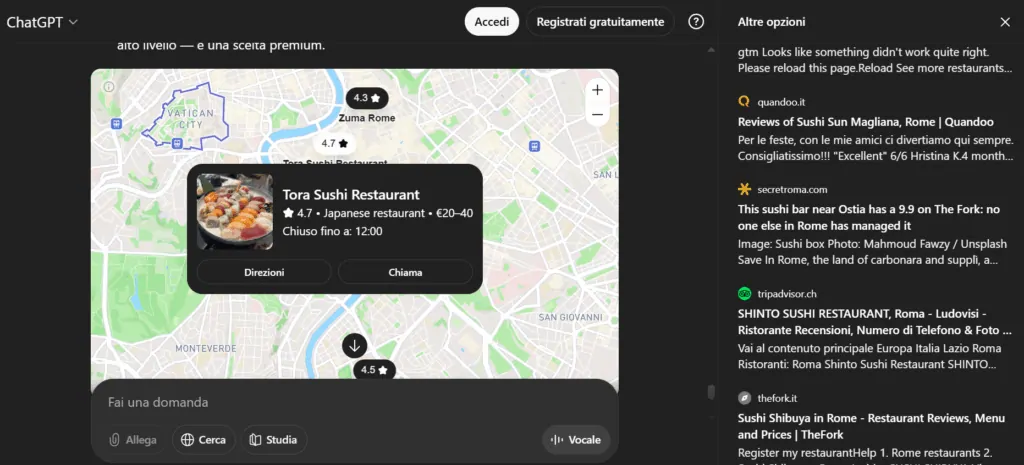
Work on the most widely used local directories, including:
- Bing Places
- Tripadvisor
- Google Business Profile
- Apple Maps
Even though ChatGPT relies on Bing for its search needs, it is still worth claiming and optimising a local listing such as Google Business Profile. Google is the number one search engine, so publishers on other websites (such as those writing round-ups of the best restaurants in city XYZ) probably use it to look things up.
Alongside this ChatGPT SEO step, you can apply another local SEO practice: put your business name, address and opening hours on your website. Most businesses put this information in their site footer or on a contact page (as in the example below).
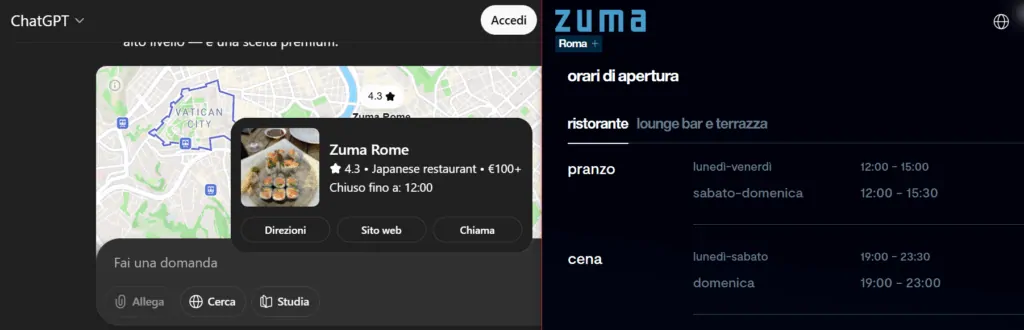
You can find the details on local listings in our guide to local listings.
How to use ChatGPT for SEO
Now that you know how to rank in ChatGPT searches, you may be wondering whether ChatGPT can help you with these tasks (or others) to improve your position in search results. The answer is yes.
Here is how you can use ChatGPT for SEO:
- Keyword research: use ChatGPT to find keywords based on your page's topic, to help you rank for related searches.
- Meta tags: ChatGPT can help you write title and meta description variants you can use to improve your pages' rankings.
- Schema markup: with ChatGPT you can create all types of schema markup, such as FAQ or LocalBusiness, to add to your website: schema gives context to search and generative engines.
- Content creation: content is a key part of SEO success, and ChatGPT can help. It can generate topic ideas, draft outlines and suggest keywords for your pages.
- Find third-party sites: ChatGPT can help you draw up a list of the best affiliate, news and aggregator sites to contact, so you can get featured on them and improve your chances of appearing in ChatGPT's results.
How to track ChatGPT rankings
As with other answer engines, tracking your position in ChatGPT's answers is not as easy as tracking rankings in traditional search results such as Bing or Google. Businesses often end up using a Microsoft Excel or Google Sheets file to track rankings by hand.
There are also tools, AI Overview checkers, that help you find out whether your site appears in AI results.
Get found in ChatGPT with AI SEO
You now know the basics of SEO for ChatGPT and are ready to start ranking in its answers. For professional support, contact us for a tailored strategy to improve your visibility on ChatGPT, Perplexity AI and Gemini.
FAQs about ChatGPT and SEO
Below are answers to the most common questions about SEO for ChatGPT:
How long does SEO for ChatGPT take?
SEO for ChatGPT can take anywhere from a few weeks to several months. It depends on the brand's existing SEO. Businesses that have not yet started SEO (or have paused it) often see a longer time-to-value (TTV) than businesses with an established SEO programme or those working with an AI-focused marketing agency.
Is it worth optimising for ChatGPT?
Yes. ChatGPT is the most popular AI platform and currently ahead of Gemini, Perplexity, Claude and the rest. Over 300 million people use it every week, and that number is expected to grow as different generations adopt AI.
Optimising for ChatGPT now, rather than once it is as embedded in our lives as smartphones, gives your business a competitive edge. You will have the visibility, and the ability to keep your brand visible, in ChatGPT searches.
Find out more: How to rank in ChatGPT
How can I use ChatGPT for SEO?
As well as improving their visibility in ChatGPT's answers, businesses can use ChatGPT to streamline SEO processes. The most common SEO uses of ChatGPT include generating schema markup, coming up with content ideas, competitor research and more.
Will ChatGPT replace Google Search?
AI tools like ChatGPT are changing a lot, but Google Search is not standing still. Google is building AI such as Gemini into search to improve it further. We see the future as a mix: the Google we know, powered by AI.
