
Key takeaways
- Google's core (and long-standing) systems still apply: AI Overviews use PageRank, reviews and helpful content to rank results.
- AI models shape the ranking: systems such as Gemini, PaLM 2 and MUM influence how AI Overviews generate answers.
- Google's databases feed the results: the Shopping Graph and Knowledge Graph provide context.
- Topic and intent matter: informational or YMYL topics affect visibility in AI Overviews.
- Structured data and visuals help: schema markup and multimedia content raise the chances of being cited.
What are AI Overviews?
AI Overviews are AI-generated snapshots shown in Google's search results. These summaries help users search faster by giving the basics of a topic, along with links to read more, such as the difference between dark and medium roast coffee (see the image below).

In this guide:
- When do Google AI Overviews appear?
- Check whether your site appears in AI Overviews
- What determines AI Overview rankings?
- How do AI Overviews affect SEO?
- How can I track my performance in AI Overviews?
- How to rank in Google AI Overviews
When do Google AI Overviews appear?
According to Google, AI Overviews appear when its systems "determine that generative AI can be especially helpful". Recent research found AI Overviews on 30% of searches, with informational searches the most common.
From the user's point of view, these AI summaries at the top of the page make sense.

Picture a group of friends trying to settle an argument: which has more caffeine, coffee or tea? A Google search gives the answer in an AI Overview: coffee generally contains more caffeine than tea. No other result on the page answers it as directly.
Argument settled.
Check whether your site appears in AI Overviews
Not sure whether your website appears in AI Overviews? See our list of free AI Overview checker tools to find out.
What determines AI Overview rankings?
Our research into the ranking factors behind AI Overviews found the following factors:
- Google's core ranking systems, such as PageRank, Reviews and Helpful Content
- AI models, such as Gemini, PaLM 2 and MUM
- Databases, including the Shopping Graph and Knowledge Graph
- Topic, for example whether it concerns money or health (YMYL)
- Search intent, for example whether the search is informational or transactional
- Multimedia, such as videos or images
- Structured data, such as LocalBusiness, Product and FAQ schema markup.
How do AI Overviews affect SEO?
For users, AI Overviews can make finding information quicker, as long as the box does not give wrong information. But what about SEO?
AI Overviews affect search engine optimisation (SEO) on three levels:
1. Visibility
Google's AI snapshots sit at the top of the results and take up more than 1,700 pixels. Inside the overview, users see the AI-generated answer plus three main links to explore (they can expand the snapshot to see all the recommended links).
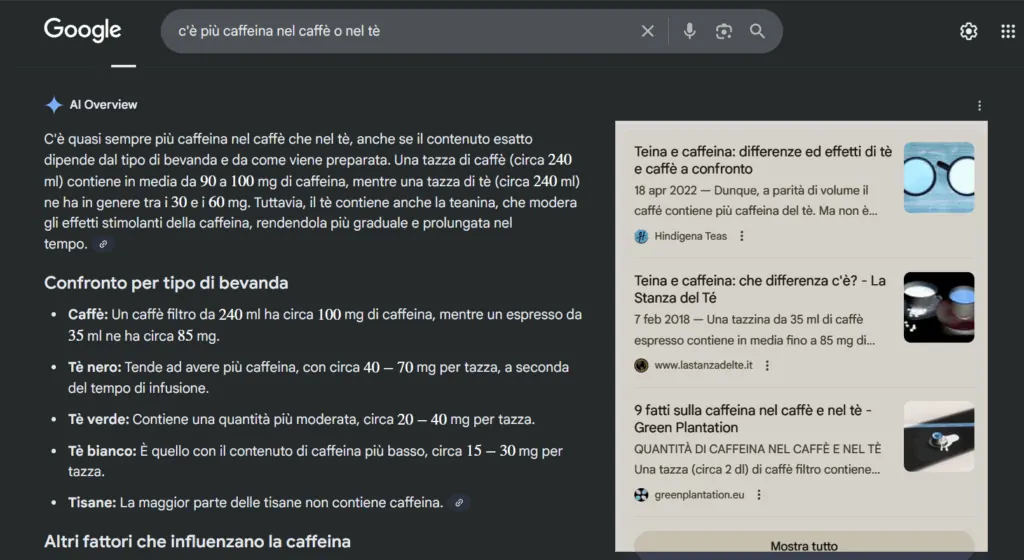
Websites in those top three links benefit from the AI Overview, while sites outside them lose visibility. Traditional organic results, for example, are pushed more than 140% further down the page.
This makes earning a place in AI Overviews more important (and that usually still means ranking well in the traditional results: two of the top three links in the AI Overview for "which has more caffeine, tea or coffee" also rank in the top ten below it).
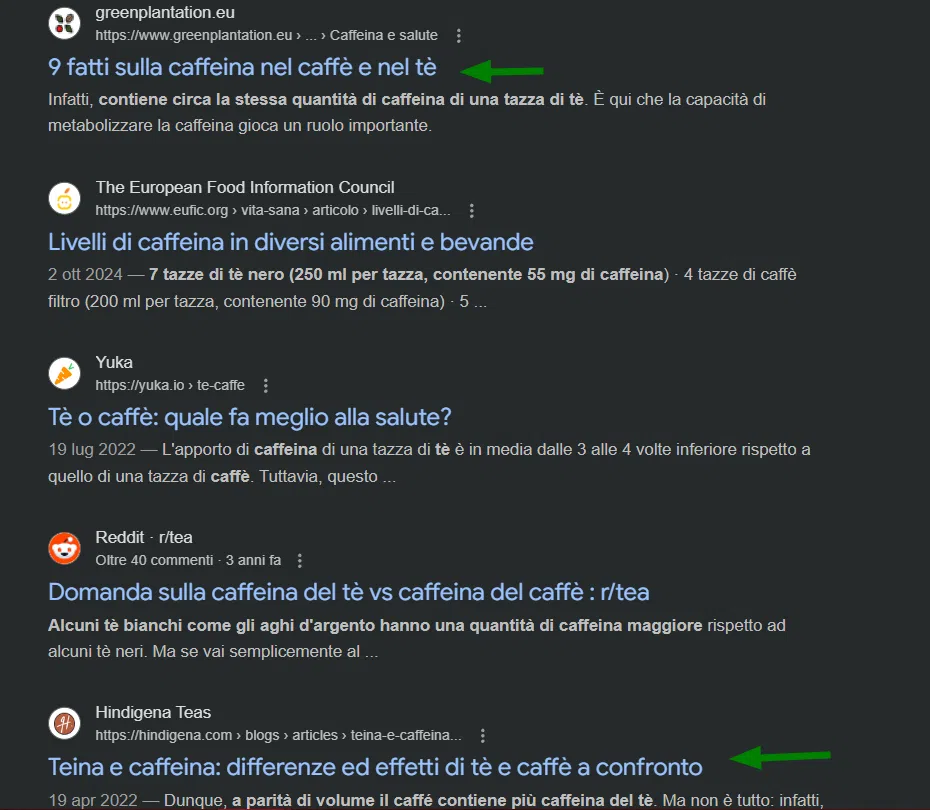
The arrival of ads in AI Overviews also affects a company's organic visibility, and can double its exposure if the company is the advertiser.
2. Traffic
Like featured snippets, AI Overviews can answer a user's question instantly, removing the need to visit a website and creating what is called a "zero-click" search. The upside of fewer clicks is the chance to attract more qualified traffic.
More and more marketers report falling traffic alongside rising revenue. HubSpot is one example: its organic traffic had fallen by 80%, yet the company grew revenue by 21% in 2024.
Take the earlier example: "which has more caffeine, tea or coffee".
Someone debating this with friends is not the ideal visitor for your website. They will most likely land on your site, find the answer and leave. Their interest in your product or service is zero.
By contrast, someone thinking about a lifestyle change, such as cutting down on caffeine, is more qualified. Their visit is more likely to turn into a more qualified session, such as reading the page in depth to see how caffeine levels vary between types of tea and coffee.

For SEOs, this is one of the hardest changes to manage. A key step is understanding which queries are most likely to produce a zero-click search. Our study of the SEO impact of AI Overviews gives data on this, showing how often AI-generated answers appear across different keyword categories.
As well as resetting expectations (sites are forecast to lose 25% of search volume to AI features such as AI Overviews), SEOs need to explain to senior management that search engine optimisation is still a worthwhile investment, because good SEO is the basis for appearing in AI-driven search experiences.
3. Revenue
AI Overviews can also affect SEO revenue.
This usually happens when companies do the bare minimum on SEO or stop investing in it. Established research shows that companies that rank well in organic results are more likely to appear in AI Overviews:
- 74% of the top three websites in AI Overviews rank in the top 10 (Authoritas)
- 73% of websites in AI Overviews rank in the top 10 (SE Ranking)
Bear in mind that Google keeps developing AI Overviews. The company plans to invest $75 billion in AI projects and is already seeing a return in traffic and ad revenue from AI Overviews.
Taken together, these changes to visibility, traffic and revenue are pushing SEOs to rethink:
- Success metrics
- Optimisation strategy
- Reporting to senior management.
For companies that want to handle these challenges, generative engine optimisation services are designed for exactly this: staying visible in a search environment that keeps changing.
How can I track my performance in AI Overviews?
You can't, at least not without a third-party tool.
Impressions, clicks and average position from AI Overviews (and AI Mode) are included in Google Search Console, but they cannot be filtered yet. So there is no way to separate AI Overview data from traditional search results data. Several SEOs have tried workarounds, but most of them have limits.
How to rank in Google AI Overviews
The most effective ways to rank in Google AI Overviews include:
1. Follow SEO best practice
For AI Overviews, Google reuses its core ranking systems, which include:
- PageRank
- RankBrain
- BERT
- Helpful content
- Freshness (how up to date the content is)
- Reviews
- And more.
Following best practice in line with these systems gives your business a starting point for appearing in AI Overviews. In most cases, companies that want to get into AI Overviews are already doing SEO.
Some examples:
- Producing unique, useful and timely content
- Earning relevant backlinks through useful content, tools or case studies
- Attracting online reviews, for example on Google Business Profile and other third-party sites
- Building a site architecture that is well organised for users and crawlers
- Researching relevant phrases and using them in URLs to reach users.
2. Add something extra to your content
Generative AI engines such as ChatGPT, Microsoft Copilot and AI Overviews respond to content that includes:
- Anecdotes, such as first-hand experience
- References, such as recent studies, internal data and news
- Direction, for example "Monitor for 10 days" rather than "Monitor the data".
This is similar to improving E-E-A-T, meaning Experience, Expertise, Authoritativeness and Trustworthiness. Talking to customer-facing colleagues and keeping up with changes in your industry are good ways to find useful material. Data on which sources generative answers cite is collected in our analysis of AI content and SEO.

The example above shows how Google AI Overviews use content.
With this answer, users no longer need to search forums or websites to make cold brew without a French press. The answer is all there: how to prepare the ground coffee, where to keep it, how long to leave it and how to serve the cold brew the next day.
3. Anticipate the next step
The name says it all: AI Overviews give an overview of a topic.

For example, a search for "what is cold brew" answers these questions:
- What is cold brew?
- How is cold brew made?
- How is it different from iced coffee?
- How do you store it?
- How do you drink it?
That is a lot of information, and a guide to cold brew can cover all of it, following what users want to learn first, second, third and so on. So when you write SEO content, think about the user's next step or need and build it into the page.
4. Use structured data
Using structured data is like calling the search engines directly. Structured data gives them direct, organised information about a URL, for example the product on the page, its price, stock level and more.
Take this AI Overview for "how long does it take to make cold brew".
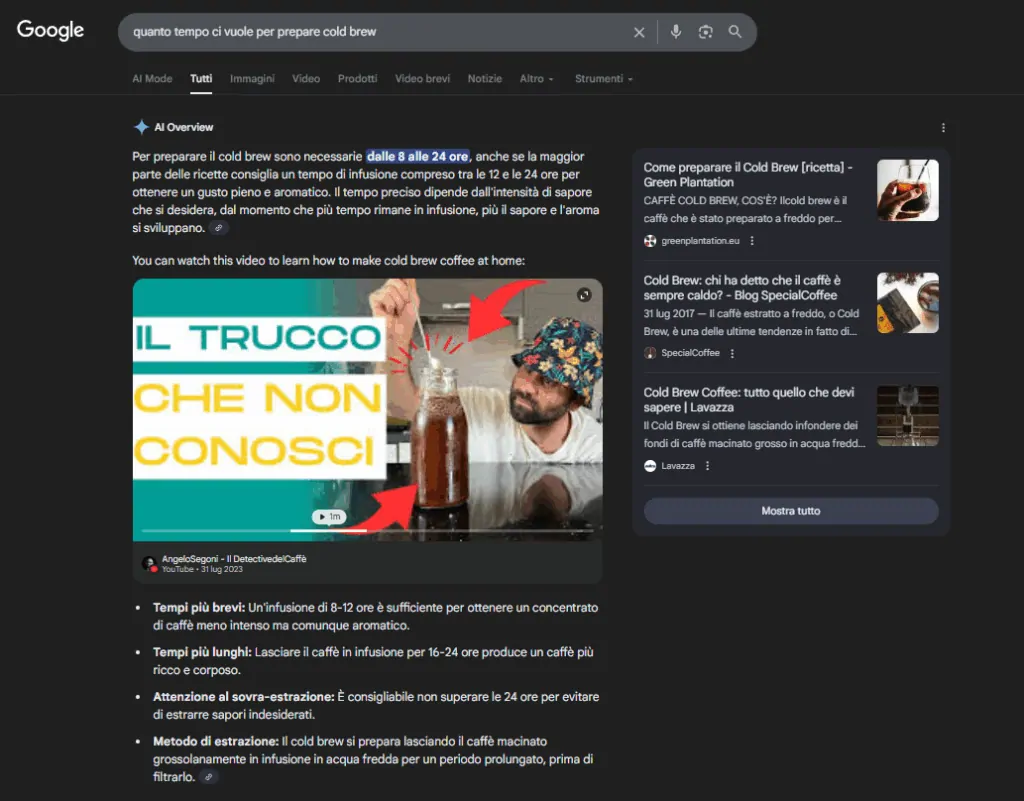
The AI Overview can include sites that use Recipe markup:
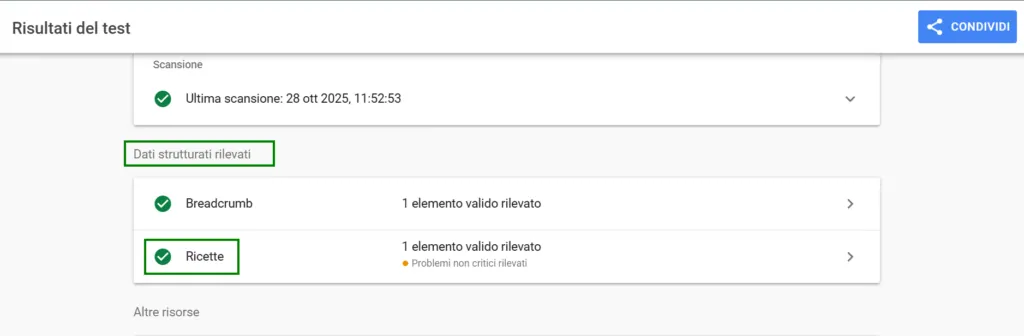
Free markup generators such as Structured Data Markup Helper make it easy to create structured data for your website. Common types include Recipe, Product, FAQ and Article. Just make sure the markup describes your page accurately.
5. Include multimedia content
There are plenty of multimedia options for web content, including:
- Video
- Images
- GIFs
Multimedia gives users other ways to engage with the content, such as watching a video to understand the difference between cold brew and iced coffee, or following a complex process such as cell division through two animated videos that make the explanation easier to grasp (as in the AI Overview below).

When you create multimedia content, think about what would help users and improve your content. Someone reading an introductory guide to cell division, for example, will probably find a diagram or video of the stages useful.
You can create multimedia content in several ways, such as working with a freelancer or using a free tool like Canva. Either way, follow SEO best practice: write alt text for images and upload videos to YouTube (Google AI Overviews are more likely to cite YouTube videos).
Read more:
- How to rank in answer engines
- AEO vs. SEO
- How to use AI in digital marketing
- What is omnichannel SEO?
Rank in AI Overviews with Visilay
You now know the basics of AI Overviews and how they work. The next step is to make them work for you, with more visibility and better-quality traffic. To find out how Visilay can help you build a strategy for AI Overviews and track your progress, get in touch.
