
Key takeaways
- Google Gemini draws on Google's core ranking systems, such as RankBrain, BERT and PageRank, so ongoing SEO work remains the basis of visibility.
- Appearing in Gemini's answers depends on matching the conversational, question-based way people search and the real intent behind it.
- Readable, well-structured content backed by E-E-A-T principles performs better in Gemini's AI-generated answers.
- Regularly updated content is treated as more useful and can be mentioned more often in answers.
- Schema markup and online citations improve the way Gemini interprets and summarises a website's content.
How to rank in Google Gemini
Here is how to rank in Google Gemini:
- Follow SEO best practice
- Target conversational phrases
- Improve content readability
- Demonstrate E-E-A-T
- Update content regularly
- Use schema markup
- Earn citations
1. Keep doing SEO
Across hundreds of AI-focused search engine optimisation (SEO) campaigns, we have seen first-hand that websites which keep investing in SEO get better results in Gemini's answers than businesses that don't.
The reason is that Google's AI uses several of its core ranking systems, such as:
- RankBrain
- BERT
- PageRank
- Reviews
- Helpful content
- Passage ranking
Traditional SEO and AI SEO also overlap on the optimisation work itself, which covers:
- Making content discoverable and accessible to web crawlers
- Producing authoritative content that adds something new to a topic
- Helping crawlers understand context, for example with schema markup and better readability.
Businesses that want to appear in Gemini should also cover other SEO basics, such as:
- Using HTTPS to secure the site
- Optimising page speed to improve user experience
- Building a trustworthy backlink profile.
For more on getting the fundamentals right, read our beginner's guide to SEO.
2. Target conversational phrases
The way people search is changing, especially on an answer engine like Google Gemini. Instead of typing phrases like "best summer destinations", they ask questions or describe their situation, for example "what are some good places for a summer holiday?".
This shift is why omnichannel SEO strategies matter: they need to work both for traditional keyword searches and for more conversational AI queries.

For an SEO, this means approaching keyword research differently.
Rather than relying on a keyword research tool (there isn't one for answer engines), think about how the search would change if you were asking a friend or relative. Instead of "best summer destinations", they might say:
- We're looking for somewhere child-friendly for the summer
- We want to go abroad this summer
- We're thinking about a weekend away over Halloween.
Each of these points to a different need and intent, such as a child-friendly destination or a short break during the holidays. From this, you can build target phrases (much as you would in SEO):
- Main: what are some good summer holiday destinations?
- Subtopic: what are some good family summer holiday destinations?
- Subtopic: what are some good summer holiday destinations abroad?
- Subtopic: where can we go for a Halloween weekend break?
You can then target these phrases with individual pages or with comprehensive guides. A guide to summer holiday destinations, for example, could cover the best options for families, for trips abroad or for specific events.
Read more about the differences between AEO and SEO
3. Improve content readability
Answer engines such as Google, ChatGPT and Perplexity AI generate answers from the user's input, for example "what are some good family summer holiday destinations", from their training data and from content on the web.
Research has shown that easier-to-read content is more visible in these engines, Gemini included. From the user's side this makes sense: you want answers, not more questions, which is why readability counts.
There are several ways to improve content readability, including:
- Organising content into subsections, such as "Summer destinations for families"
- Using tables to structure information, for example to compare the pros and cons of each destination
- Tidying up the prose, for example by fixing disjointed sentences or using simpler words.
A readability tool, such as the Flesch Reading Ease score built into Yoast SEO (the WordPress plugin), can help. AI can help too: upload or paste the text into a tool like Claude and ask for practical suggestions on making it easier to scan and read.
4. Demonstrate E-E-A-T
Google has promoted Experience, Expertise, Authoritativeness and Trustworthiness (E-E-A-T) for years, so it follows that Google Gemini mentions and cites brands that show these qualities.
A few ways to build E-E-A-T:
- Highlight certifications, awards or partnerships
- Share first-hand experience ("My family went to XYZ for our summer holiday and...")
- Give specific information ("Humidity is low here, which makes it a good choice for a summer holiday.")
To demonstrate E-E-A-T, be more specific in your content. Gemini and other answer engines aim to give personalised advice and often prompt users for more detail. In the answer below, for example, Gemini asks for more information to help plan the next holiday:

You can add this kind of information to your content. For example:
| Destination | Price (3-7 days) | Best for |
| Paris, France | ££££ | Romantic break |
| Santorini, Greece | £££ | Relaxing break |
| Costa Rica | ££ | Adventure trip |
You don't have to come up with these ideas on your own. Chatting with Google Gemini can generate ideas for showing the expertise, experience, authority and trust you have on a topic.
5. Update content regularly
Another effective way to appear in Google Gemini's answers is to update your content.
The aim of these updates is simple: add value. Don't just change a few words or figures (such as the date). Research the topic and the page to see what has changed since it was published and what you can add.
A travel guide to a summer destination, for example, could simply refresh its prices (see the example above). Or it could go further and add value by covering what has changed at the destination.
Paris hosted the 2024 Olympic Games, for instance. What did that mean for travellers that year? How could they buy tickets for events? What could they expect when getting around and eating out in the city?

6. Use schema markup
Using schema markup is another effective SEO tactic for Gemini. Markup helps search engines and answer engines understand a page and its content. Recipe markup, for example, can help these engines summarise:
- Ingredients needed
- Total preparation time
- Total cooking time
- Nutritional information

In these answers Gemini may cite specific sites. If you check those URLs in Google's Rich Results Test, you will often find that they use recipe schema markup and list the ingredients with recipeIngredient.
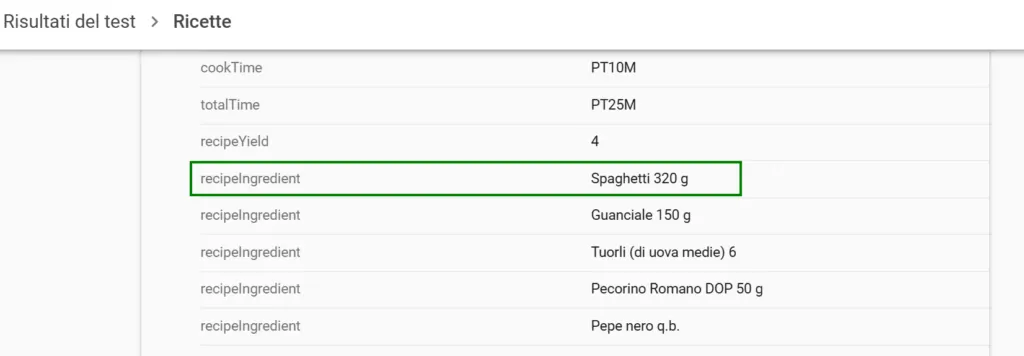
You can generate schema, from recipes to FAQs, with a free tool such as Google's Structured Data Markup Helper.
7. Earn online citations
Online citations are also associated with better visibility in Google Gemini:
- Local directories
- Social media profiles
- Unlinked mentions
- Backlinks
- Reviews
You can improve your online citations through direct actions, such as claiming and optimising a local listing (like a Google Business Profile), or indirect ones, such as publishing high-quality content that adds something new to a topic, for example a quiz to find the ideal summer destination.
How to track your visibility in Google Gemini
To track rankings in Google Gemini:
- Enter your target query in Gemini
- Check the answer for brand mentions or website citations
- Log the results in a Google Sheet or Microsoft Excel file.
Beyond this manual process, you can try dedicated AI visibility tracking tools.
Get noticed in Gemini with AI SEO
You now know how to rank in Google Gemini: time to start optimising. For professional support, have a look at our AI SEO services. Get in touch for a strategy built around your business.
Frequently asked questions
Quick answers to common questions:
What is Google Gemini?
Google Gemini is an AI-powered answer engine available to Google users. Like other answer engines, Gemini includes brand mentions or website citations in its text answers. Users can also generate images with Gemini.
What is AI SEO?
AI SEO means using artificial intelligence for SEO tasks, such as generating title tag ideas, or optimising a brand's visibility in AI-powered experiences (also called search everywhere optimisation).
To see how marketers are using AI in SEO in 2025, have a look at the latest AI SEO statistics.
Is it worth optimising for Google Gemini?
Although Gemini had fewer users than Meta AI and ChatGPT, it was still the third most popular answer engine, with 140 million users according to Exploding Topics. Add the billions of people who use Google Workspace and Google's planned $75 billion investment in AI, and optimising for Gemini is a sensible choice.
How long does it take to rank in Google Gemini?
Ranking in Google Gemini can take weeks or months. It depends on several factors, including the website's current SEO position, the target phrase and the other websites competing for that answer.
