
People looking for an industrial supplier don't type a company name. They type a process, a material, a size. That is the difference between SEO for manufacturing and SEO for an e-commerce site, and it is why so many industrial websites stay invisible on exactly the searches that would bring in requests for quotes.
SEO for manufacturing is the work that makes a manufacturer findable on Google when a buyer searches for a process, a component, a material or a certification instead of a supplier's name. It differs from general SEO in three ways: the site architecture follows production capabilities rather than the sales catalogue, the keywords are technical and low volume, and results are measured in quote requests, not visits.
Below is the method we apply on industrial projects and the numbers from a real case: Macropix, a Milan-based manufacturer of custom LED screens, which went from absent to first position on a keyword with 4,400 monthly searches on Google Italy.
The industrial buyer isn't searching for your name
In B2C, searches often start from the brand. In manufacturing almost never. Whoever has to buy searches by process (subcontract CNC machining), by material (stainless steel fabrication), by application (outdoor LED screen), by certification (ISO 9001 manufacturer) or by location. In the UK these searches are small and expensive: "cnc machining services" has 880 searches a month with a CPC of £23.30, "stainless steel fabrication" 880 at £8.37, "subcontract cnc machining" 40 at £7.42 (DataForSEO, Google UK, September 2026; CPC converted from USD at £1 = $1.3242).
One figure makes it concrete. Of the nine keywords that currently bring Macropix the most qualified leads, none contains the company name. The biggest is "ledwall", the term Italian buyers use for an LED wall, with 4,400 searches a month. The other eight are product or application descriptions: the Italian for "advertising screen", "advertising monitor", "LED totem", "outdoor LED wall".
If your site is built around the company rather than around what the company can do, someone else picks up those searches. The principle applies to all B2B and we developed it in the guide to B2B SEO strategy; in manufacturing it is simply more extreme, because the technical vocabulary is more precise.
Four people decide, four different searches
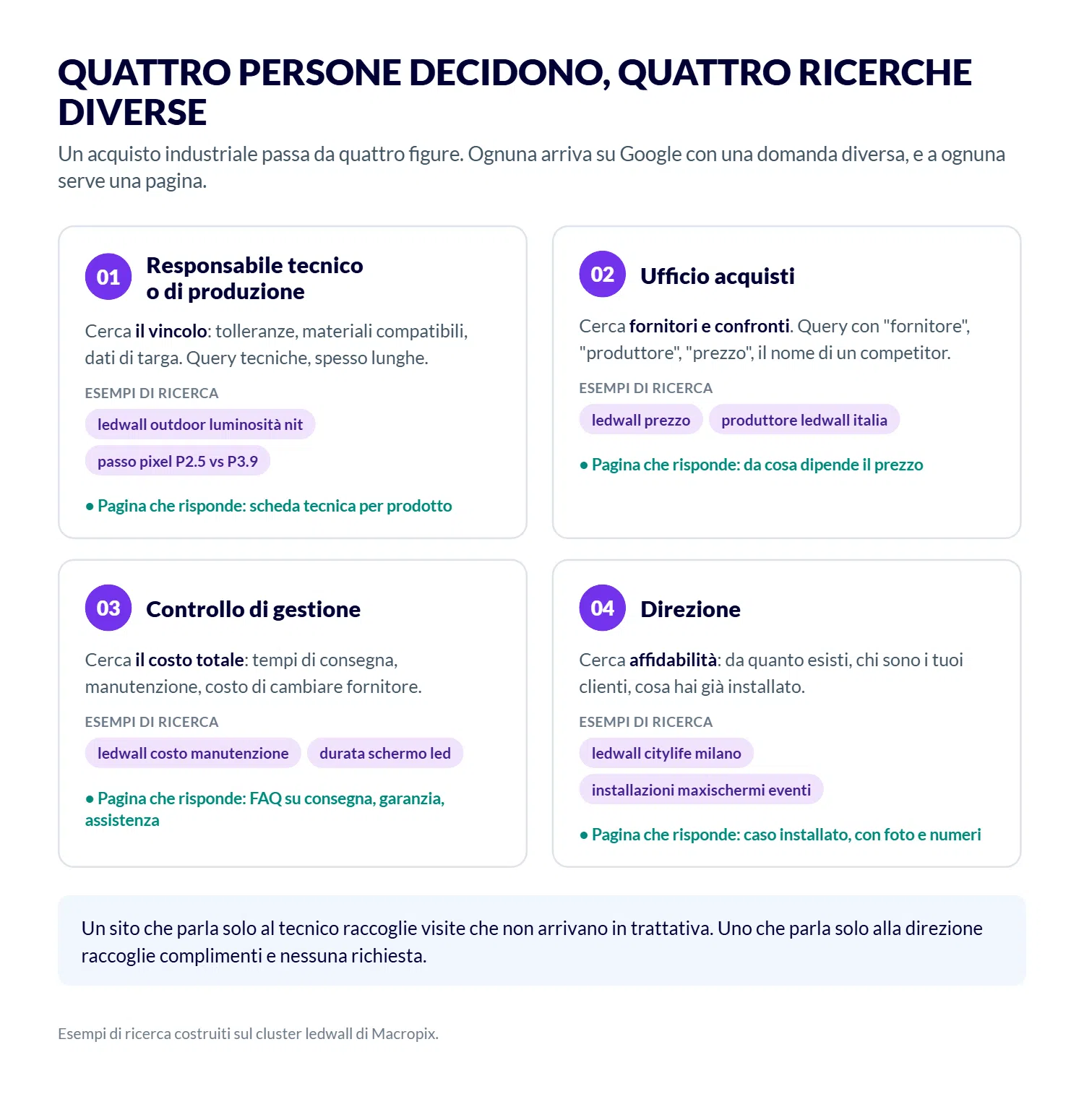
An industrial purchase isn't decided by one person. In the projects we manage the process usually involves four people, and each of them arrives on Google with a different question.
- The technical or production manager searches for the constraint: tolerances, compatible materials, rated specifications. Technical queries, often long ones.
- Procurement searches for suppliers and comparisons. Queries with "supplier", "manufacturer", "price", a competitor's name.
- Finance searches for total cost, lead times, the cost of switching supplier.
- Senior management searches for reliability: how long you have been around, who your customers are, what you have already installed.
A site that speaks only to the first person collects technical visits that never reach a negotiation. One that speaks only to the last collects compliments and no enquiries. You need a page for each question, and installation case pages count as much as product pages: Macropix has one for every major installation, from the LED wall at CityLife in Milan to set-ups for Milan Design Week's Fuorisalone.
Knowing in advance who these four people are is the same work you do before a B2B outbound campaign. The difference is that here you don't contact them: you wait for them where they search.
The mistake that wipes out everything: the "Products" page
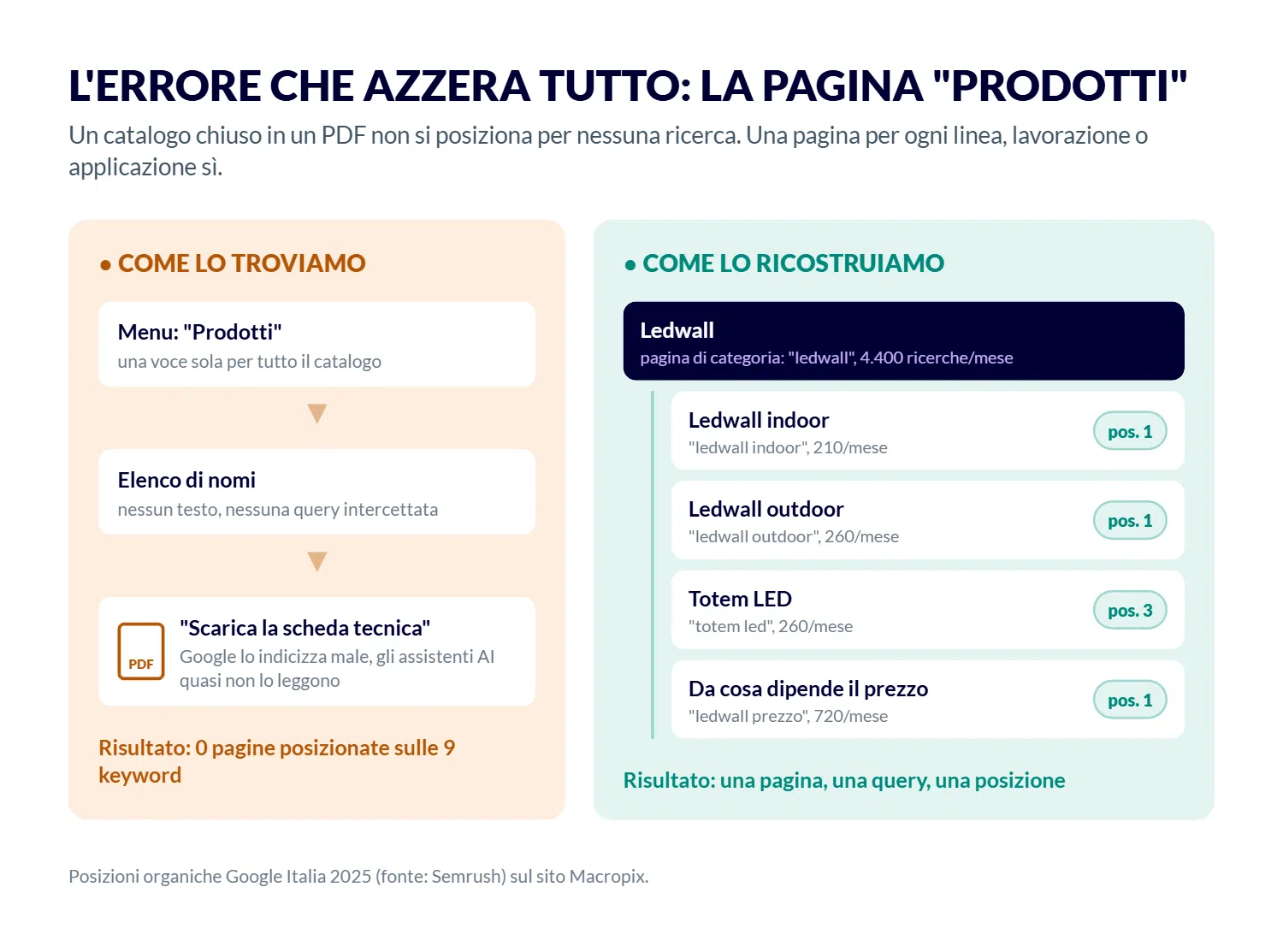
It is the mistake we find most often, and it costs more than any technical problem. The site has a "Products" menu item, inside there is a list, and for the details you download a PDF.
That PDF is invisible to search in the way that matters: Google indexes it poorly, AI assistants barely read it, and none of its pages can rank for a specific query. All the company's technical content, the part that is really worth something, is locked in a file nobody finds.
The rule is simple: every product line, every process and every application deserves its own page, with its own URL and its own text. Macropix has a page for LED walls, one for the indoor version, one for the outdoor version, one for totems. Each ranks for its own query. A single "Products" page would not have ranked for any of the nine.
When you rewrite those pages starting from the PDF, two things make more difference than anything else: a clean heading hierarchy, because datasheets are dense content that needs breaking up, and well-named, well-described images. In manufacturing, product and plant photos are often the only original content the company owns: uploading them as IMG_4471.jpg with no alt text wastes them.
Where the keywords nobody targets are
In manufacturing, competition concentrates on two or three generic category terms. Everything around them is left free, and it often converts better.
Three sources, in order of usefulness, and none of them needs a paid tool to get started.
- The quote requests you have already received. Read the last fifty and note the words the customer used to describe what they wanted. Those are the queries, written by the people who buy.
- The sales team. Ask which questions they hear on the phone in the first two minutes. They are usually questions nobody has ever put in writing on the site.
- Search Console. The queries report shows the searches where you already appear in positions 8-20. Those are the pages one step from page one, and it is where the work pays off first.
An example of a keyword almost every manufacturer avoids: the one with the word price in it. In Italy "ledwall prezzo" (LED wall price) has 720 searches a month and very high commercial intent, because whoever types it is preparing a budget; in the UK the equivalent "led wall price" is much smaller, 30 searches a month with a CPC of £3.19. Most companies don't target it so as not to expose their price lists. You can answer by explaining what drives the price, without publishing a price list: the page ranks anyway, and catches the moment the decision is taking shape.
Once you have the list, the work becomes writing content with SEO in mind on subjects you know better than anyone else. In manufacturing this is the biggest advantage and the most underused one: you have people in the company who know things no copywriter can make up.
The quote is part of SEO
In manufacturing almost everything is made to measure, so there is no "buy" button: in its place is the quote request. If the site brings traffic and the contact form only asks for name, email and message, you are throwing away the most valuable part of the visit.
Two changes that pay off straight away. The first: put in the form the fields your sales team asks for anyway in the first round of calls (quantity, material, tolerance, dimensions, lead time). The lead arrives already qualified and the cycle gets shorter. The second: explain what the price depends on, even without figures. A page listing the factors that push a quote up or down catches searches with "price" and "cost", and filters out on its own anyone whose budget is out of scale.
The Macropix case: from position 88 to position 2
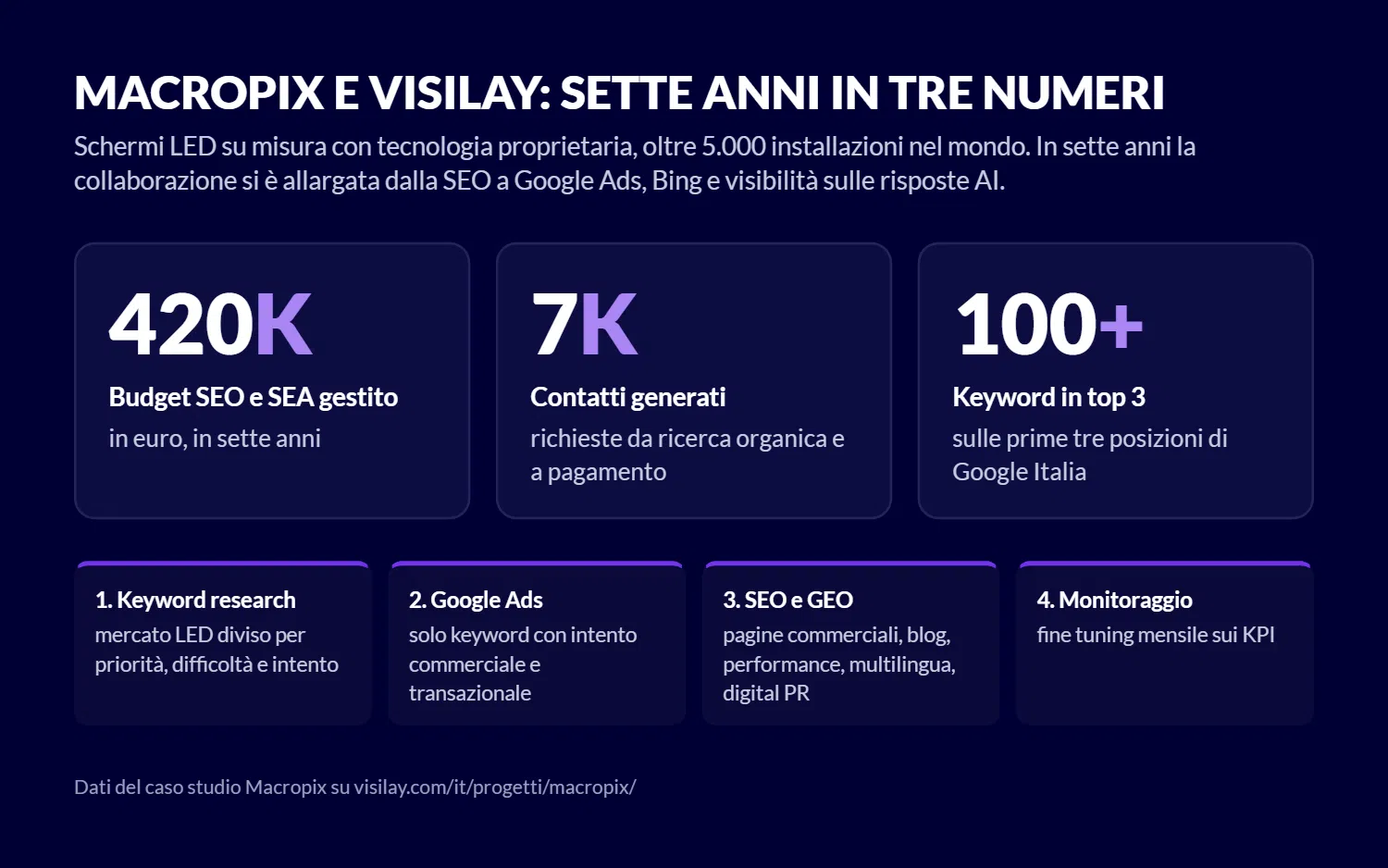
Macropix develops custom LED screens with proprietary technology and has passed five thousand installations worldwide. When the project started, in 2020, the site did not appear for any of the category keywords in its sector.
The project started with SEO and over the years expanded to Google Ads, Bing and visibility in the answers generated by AI engines. In seven years €420,000 of SEO and advertising budget has gone through the project, around seven thousand contact requests have come in, and today the site holds more than a hundred keywords in the top three positions of Google Italy.
With Visilay we started with SEO and, thanks to the results, we extended the collaboration to Google Ads, Bing and AI-related opportunities. Always professional and focused on results.
Luca Conti, CEO Macropix
The details of the work, with the client's full testimonial, are in the Macropix case study.
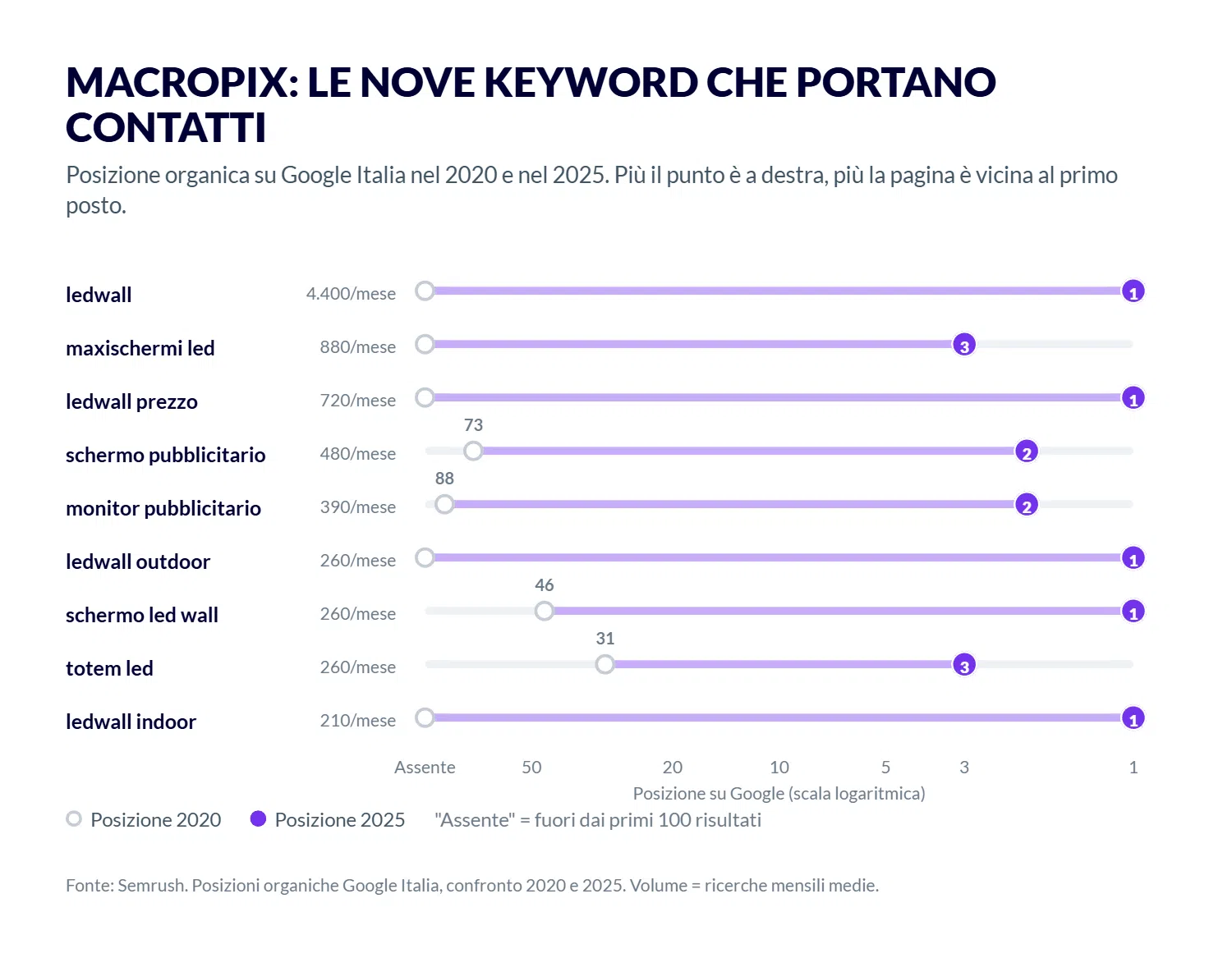
This is the picture five years on, for the nine keywords that generate the most qualified leads (Italian queries, with the English meaning in brackets).
| Keyword | Monthly volume | Position 2020 | Position 2025 |
|---|---|---|---|
| ledwall (LED wall) | 4,400 | not present | 1 |
| maxischermi led (large LED screens) | 880 | not present | 3 |
| ledwall prezzo (LED wall price) | 720 | not present | 1 |
| schermo pubblicitario (advertising screen) | 480 | 73 | 2 |
| monitor pubblicitario (advertising monitor) | 390 | 88 | 2 |
| ledwall outdoor (outdoor LED wall) | 260 | not present | 1 |
| schermo led wall (LED wall screen) | 260 | 46 | 1 |
| totem led (LED totem) | 260 | 31 | 3 |
| ledwall indoor (indoor LED wall) | 210 | not present | 1 |
The figure we most often share with industrial clients is not first place on "ledwall". It is the "monitor pubblicitario" (advertising monitor) row: from position 88 to position 2. Position 88 means page nine of Google, in other words zero traffic. It wasn't a technical shortcut, it was a well-written page on a subject where the company genuinely had something to say.
How much of the niche it holds today
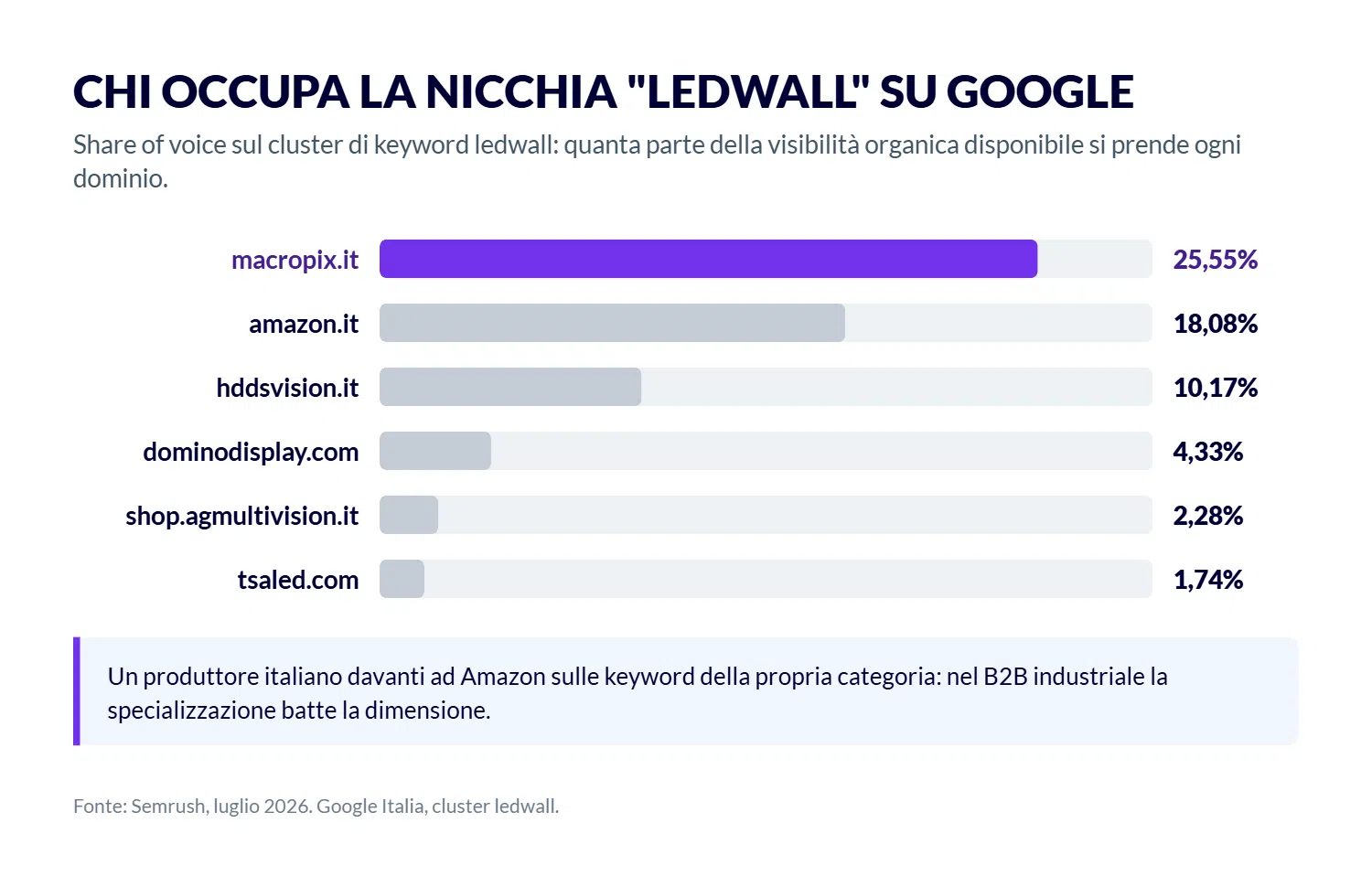
Share of voice measures how much of the total visibility available on a group of keywords a domain takes. In July 2026, on the LED wall cluster in Italy, the ranking looks like this:
| Domain | Share of voice |
|---|---|
| macropix.it | 25.55% |
| amazon.it | 18.08% |
| hddsvision.it | 10.17% |
| dominodisplay.com | 4.33% |
| shop.agmultivision.it | 2.28% |
| tsaled.com | 1.74% |
A manufacturer ahead of Amazon on the keywords of its own category is the clearest proof that in industrial B2B specialisation beats size. Amazon has unmatched domain authority. It doesn't have a page explaining the difference between an indoor and an outdoor LED wall written by the people who make them. If you are interested in the general argument, we covered it in how company size shapes SEO strategy.
The paid side, for comparison
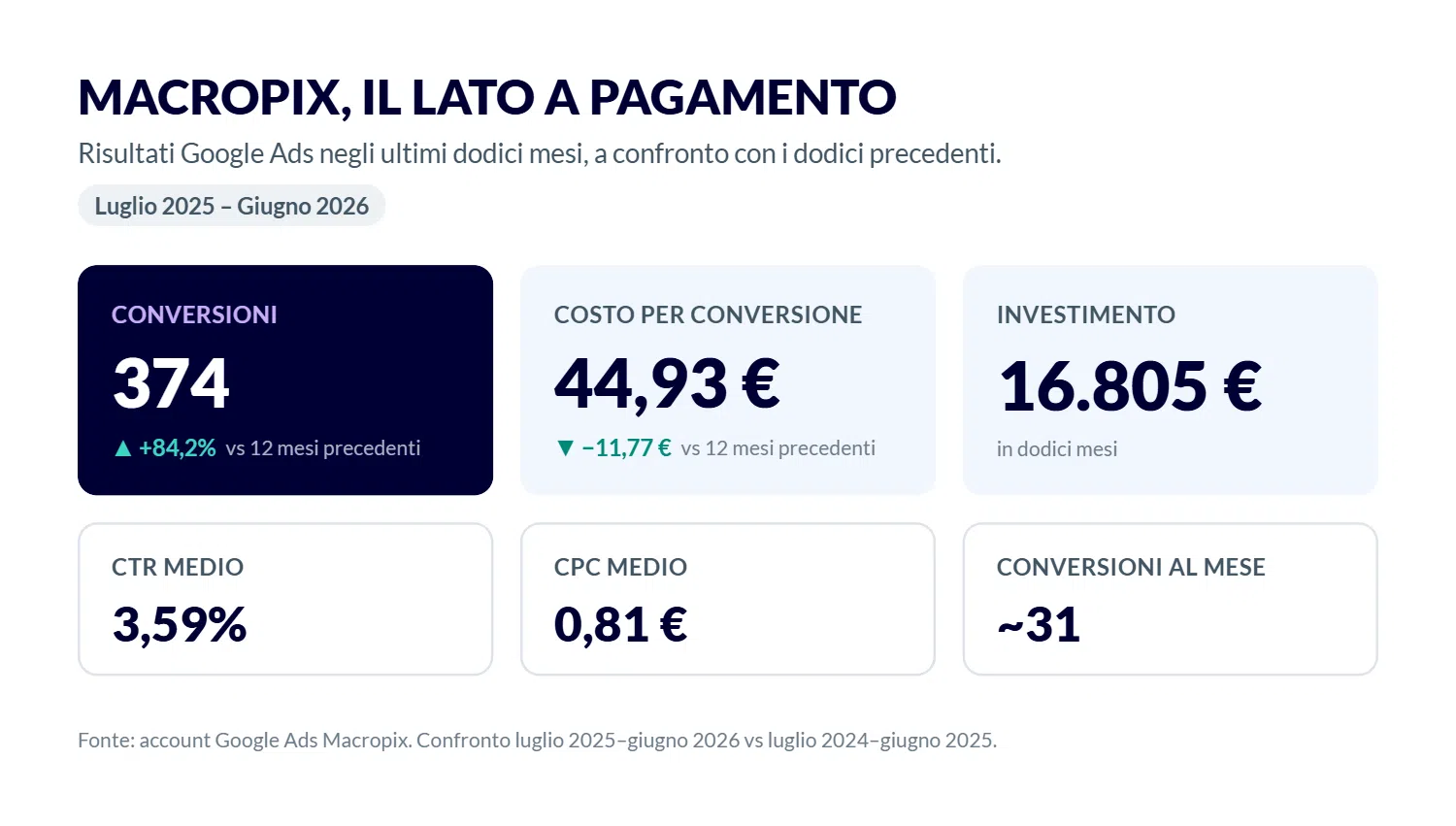
On the same account, between July 2025 and June 2026, Google Ads produced 374 conversions from €16,805 spent: €44.93 per conversion, average CTR 3.59%, average CPC €0.81. Compared with the previous twelve months, conversions grew by 84.2% and cost per conversion fell by €11.77.
The comparison helps put SEO in context. The organic positions in the table above have no cost per click, but they took years to build. Ads brings leads from day one and stops the day you switch off the budget. In manufacturing, with long sales cycles, they work together: Ads covers the period when organic isn't there yet, and then stays on the commercial queries where competition is toughest. We explained how they fit together in SEO and Google Ads: how to make them work together, and how to set up the paid side in Google Ads campaigns for B2B companies.
What happens outside your website
Two channels that count for more in manufacturing than elsewhere and that almost nobody connects to SEO.
Trade shows. Every edition produces press releases, exhibitor catalogues and coverage in trade publications. These are links and mentions the company earns anyway, and they almost always end up without a link to the site, or with a link to a generic page. Asking for them to point to the right process page costs nothing and is worth more than six months of cold link building.
Industrial directories such as Europages or Kompass rarely rank you for a commercial query, but they keep your name, address and product category consistent on sources Google and AI assistants read to check the company really exists. The same reasoning applies to the Google Business Profile listing, which is more useful to a manufacturer with a plant than people think: many supplier searches have a geographic centre of gravity.
What changes now that AI Overviews are here
AI Overviews have been live in the UK since August 2024 and in Italy since March 2025. They are the summaries Google generates to answer the question above the organic results, citing the sources they took the information from.
In Italy, the market where Macropix operates, the numbers that show how much they weigh are these: 32.7% of keywords already show an AI Overview, equal to 24.7% of total search volume. When an AI Overview is present, 43% of searches end without any click.
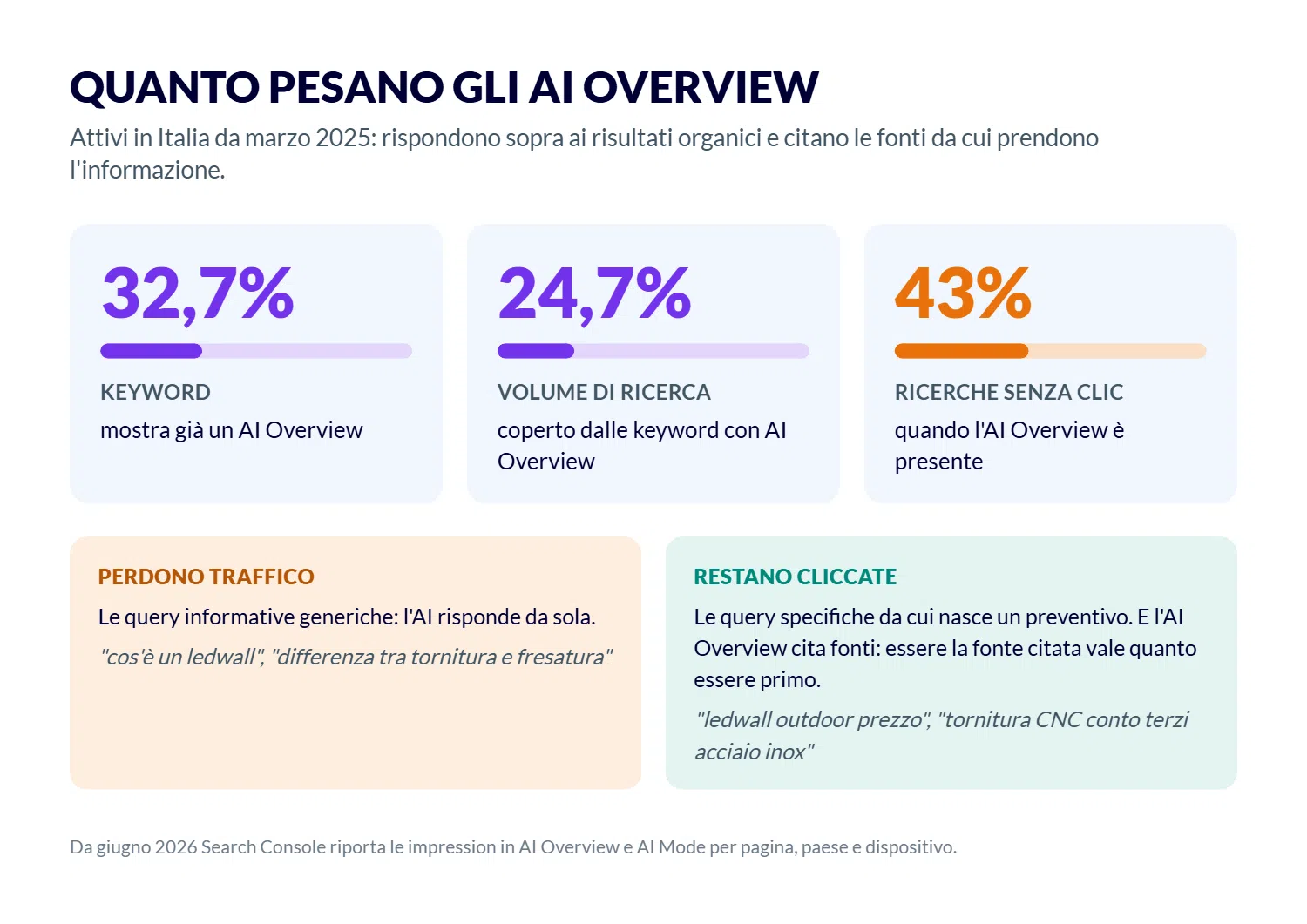
For a manufacturer the consequence cuts both ways. Generic informational queries ("what is an LED wall", "difference between turning and milling") will lose traffic, because the AI answers on its own. Specific queries, the ones a quote request comes from, still get clicked, and on top of that the AI Overview cites sources: being the cited source is worth as much as being first. If you haven't looked into them yet, start with how AI Overviews work.
Since June 2026 Search Console has included reports dedicated to AI features, with the site's impressions in AI Overviews and AI Mode broken down by page, country and device. Visibility in AI answers has become a measurable metric rather than a feeling, even though that report counts impressions, not clicks. If you have an industrial website, that report is worth opening before anything else.
The first three things to do
- Count your site's indexed pages. Search
site:yourdomain.co.ukon Google. If a company with forty processes has twelve pages, the problem isn't technical SEO, it is that there is no content to rank. - Open the Search Console queries report and filter positions 8 to 20. Those pages are already relevant to Google and it doesn't take much to bring them onto page one.
- Take the catalogue PDF and turn three of its datasheets into three web pages. The three your sales team sends most often. It is the quickest test of whether the method works in your market.
Something worth saying that the industry rarely says: industrial SEO is slow. The positions in the Macropix table are the result of five years of continuous work, not a one-off job. Anyone promising you page one in three months on "led wall" or "cnc machining" is selling something they can't deliver, and writing SEO goals nobody can meet. The upside is that once those positions arrive, it is very hard for anyone to take them away: a competitor would have to redo the same five years. If a project is already under way and you want to know whether it is going anywhere, we have written how to tell whether your SEO agency is working.
Recommended reading: how manufacturing compares with other sectors.
Frequently asked questions
How long does it take to see results?
On low-volume technical keywords the first movements show in three or four months. On category keywords, the ones with thousands of monthly searches, you think in years: for Macropix, first position on "ledwall" came after several years of work on the whole site structure.
Is SEO worth it if I only sell to a few dozen customers?
Yes, and it is where it pays off most. With a high order value, a few enquiries a year are enough to pay back the project. Search volume matters less than the average contract value: a keyword with 90 searches a month can be worth more than one with 9,000.
Should I publish prices on the site?
No. It is enough to explain what they depend on. A page describing the factors that make a quote vary ranks for searches with "price" and "cost" without exposing price lists to competitors.
Is my sector too niche for anyone to search on Google?
It is the most common objection and it almost always comes from having looked only at the generic category term. Industrial traffic sits in long, technical queries, which keyword research tools often mark as zero volume because they are below the reporting threshold. The Search Console queries report shows reality: those searches exist, there are few of them, and they are made by people who are buying.
Do I need an agency or can it be done in-house?
The part nobody can do for you is the technical content: that is in your engineers' heads. Site structure, keyword research and the technical side can be outsourced. The model that works best in manufacturing is a mix: the company provides the subject matter, the SEO side organises it. The reasoning also applies to small businesses, as we explain in the guide to SEO for small and medium-sized businesses.
The same pattern, one page per process and one for each finished job, works on building sites too: for a construction or renovation company we applied it to real SERP data in SEO for construction companies.
The maths between cost per click and cost per enquiry changes a lot from sector to sector: for an estate agency, where valuation clicks cost far more than listing clicks, we worked it out in Google Ads for estate agents.
The same principle, one page for each thing you can do, applies in a sector dominated by portals: for an estate agency it is the area pages and the Google listing that get it onto page one. We show it with data in real estate SEO.
At the opposite end from manufacturing are the sectors where the website counts for less than the Google listing: on a typical restaurant search the local pack takes the space that would otherwise go to restaurant websites. We cover it in SEO for restaurants.
The reasoning on dedicated pages also applies outside industry: for a multi-specialty clinic the pages that rank are the treatment and location pages, as we show in SEO for healthcare.
If you sell online and the pages that matter are categories and product pages, the reasoning changes: we wrote it up in the guide to e-commerce SEO.
The same method, applied to a sector where the operator's site competes with large groups on destination pages, is in the guide to tourism SEO.
The method changes a lot from sector to sector: in hospitality, for example, the first organic page is taken by the OTAs and the work shifts to the Google Hotels listing and the brand, as we explain in SEO for hotels.
If your business is local and runs on appointments, we worked out the maths between cost per click and cost per enquiry with real CPCs in Google Ads for dentists.
The reasoning on process pages also applies outside industry: for a dental practice the prices page and the treatment + city pages do the same job, as we show in SEO for dentists.
