
If you want to build a predictable B2B outbound channel, this guide is for you. We will cover what outbound is compared with inbound, when it makes sense, and above all how to build a system that scales, from defining the ICP to a concrete action plan that includes targeted use of AI in sales. At the end you will find tables, checklists, FAQs and useful links for further reading.
What B2B outbound is and how it differs from inbound
B2B outbound covers every proactive activity in which you start the conversation with potential customers. This includes cold email and cold calling, outreach on LinkedIn and direct mail.
Inbound, on the other hand, is the opposite approach: you attract potential customers with content and SEO work, then wait for them to take the first step.
In complex sales, outbound gives you precise targeting and control over timing and messaging, but it always needs to work alongside inbound to cover the whole funnel. There is plenty of evidence that, especially in B2B with several stakeholders and longer sales cycles, combining outbound and inbound works better.
When to focus on outbound (and why it does not replace inbound)
Outbound works best when:
- your total addressable market (TAM) is defined and concentrated;
- you sell complex solutions with a mid-to-high deal value, where decision makers are not actively searching (so inbound alone has limited effect);
- you want to move into new segments or regions quickly;
- you need to fill the pipeline fast and cannot wait for inbound to pay off.
Outbound does not replace inbound: the two approaches reinforce each other. Direct conversations give you insights for SEO and ideas for new content; in turn, content builds trust and can help outbound leads convert faster.
The 8-step operating framework
With the introduction out of the way, let's move straight on to the process.
B2B outbound works when you follow a rigorous, repeatable process. That is why we recommend a framework with defined steps, which you then refine based on your results to speed up growth.

1) ICP and TAM (who to contact, and why)
Start from the Ideal Customer Profile (ICP). If you have not done it yet, define the ICP for your product or service. Key elements of a complete profile might include: sector, size, geography, tech stack, triggers (events that make a purchase more likely), and the main problems or needs identified. If you are not sure where to begin, follow our guide to understanding and creating an ICP.
You also need a clear idea of your TAM (Total Addressable Market): the number of potential customers who could be interested in your product. The ICP is a smaller slice of the TAM and represents the target you should focus on.
In B2B it helps to build account-based lists with 3-5 key contacts per account (decision maker, influencer, champion). To do this you can use lead generation tools such as LinkedIn Sales Navigator, lead intelligence tools such as Leadinfo, and a CRM.
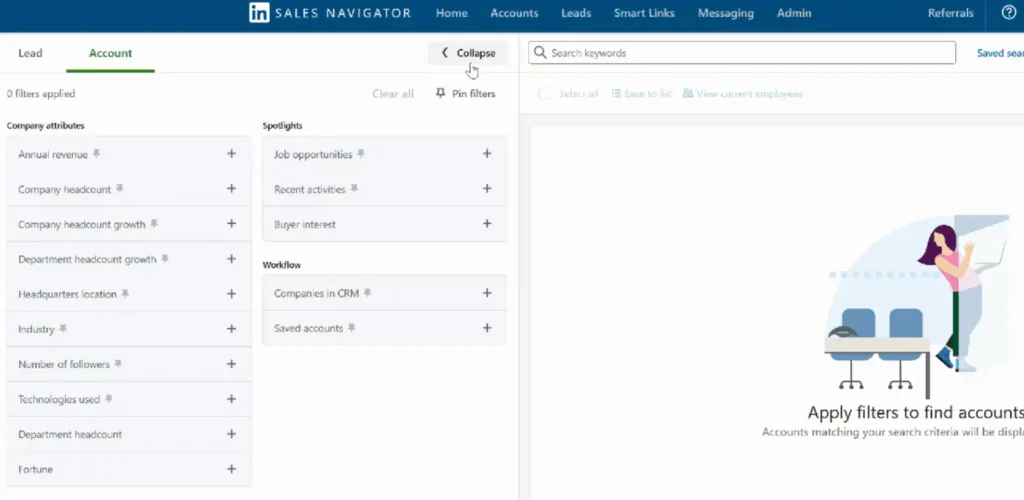
Quick ICP checklist:
- Top 3 sectors and use cases with the best fit
- Ideal size (turnover/headcount)
- Priority regions (language, regulation, channels)
- Triggers (new funding rounds, key hires, stack changes)
- Measurable pains and the buyer's priorities.
2) Research and data quality
Making sure the data you collect is accurate is essential if you want good results. For example, better deliverability means more replies and less wasted time and resources.
To improve the quality of the contacts you collect, use different sources: databases, scraping (done ethically), and first-hand research directly on company websites.
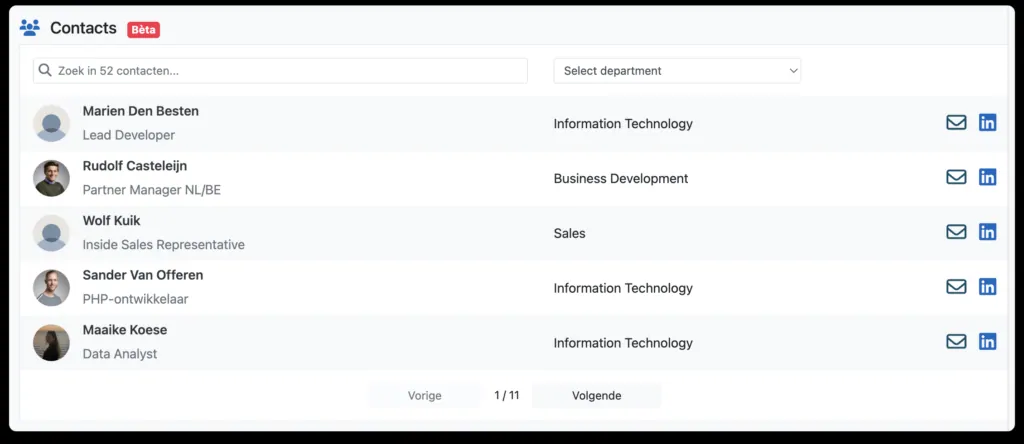
To refine your contacts, apply filters so that the people you collect match your ICP. Technical checks matter just as much, such as making sure email addresses are valid, which lowers your email bounce rate.
Once they are in your CRM, contacts still need looking after. For example, use tags and custom fields to record important details (role in the company, recent initiatives, tools used), and track the progress of each deal by updating every contact's status.
3) Messaging and value proposition
Write short, specific, useful messages. In a first contact, the opening of the message must make it clear that it is targeted and not generic (don't stop at [First name] or [Company]).
You also need to offer immediate value (for example sharing insights, a mini audit or a benchmark) and avoid generic messages.
Create variants based on a few factors to personalise the message further:
- role (e.g. CFO: interested in efficiency/ROI; CTO: integrations/resources);
- industry (sector terminology and KPIs);
- account stage (cold, warm, hot).
Here is a (very schematic) template you can use for the first outreach email:
- Subject: An idea to reduce [KPI] in [specific timeframe]
- First line: reference to a concrete piece of information (post/feature/announcement) + personalisation
- Value: 1 measurable result achieved with a similar company [link to case study]
- CTA: "If it's of interest, could we book a 15-minute call to understand your context and whether there's a fit?"
4) Multichannel sequence (with examples)
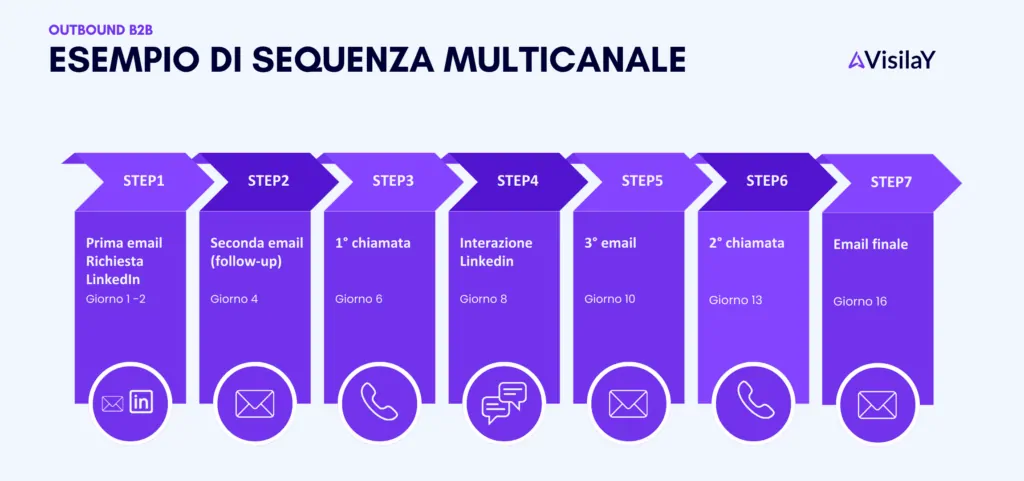
Before you act, have a defined plan. A good starting point is a contact sequence built on a multichannel strategy that combines (for example) email, LinkedIn and phone calls.
A practical example is a sequence of 10-12 touches over 15-20 days, like this one:
- Days 1-2: first outreach email → LinkedIn profile view → (personalised) connection request
- Day 4: second email (follow-up) with a new value angle (no copy-and-paste or generic emails)
- Day 6: first call
- Day 8: interaction on LinkedIn (for example a useful, non-promotional comment)
- Day 10: third email (case study/useful resource)
- Day 13: second call
- Day 16: fourth email (final email with a clear opt-out)
Give more weight to personalisation than to the number of conversations you start. To set priorities among your contacts, use interactions and key triggers (for example: a visit to the pricing page or a whitepaper download).
5) Deliverability and technical setup (essential for outbound email)
As mentioned above, deliverability is a make-or-break issue for email: the result of the campaign depends on it.
There are several things you can (and should) check before sending a campaign:
- Authenticate your domains (SPF, DKIM, DMARC) and check the records.
- Be careful with new mailboxes (ramp up sending gradually), and cap volumes per domain (you can use several domains).
- Segment by domain/industry and look after your reputation (ideally stay below these thresholds: hard bounces <2%, spam complaints <0.1%).
- Avoid words that look "spammy" and use dedicated sending domains.
6) Compliance (UK GDPR and PECR)
In the UK, B2B cold email falls under PECR and the UK GDPR. Emails to corporate subscribers (limited companies, LLPs, public bodies) do not need prior consent under PECR, provided you do not hide who you are and you give a valid address to opt out. Sole traders and some partnerships are treated like individuals, so you need their consent (or the soft opt-in). When the address identifies a person (for example [email protected]), the UK GDPR applies too: legitimate interests is usually the lawful basis, as long as the message is relevant to the recipient's role (ICO, business-to-business marketing guidance). In the EU the reasoning is similar, but ePrivacy rules vary from country to country.

Basic rules:
- Use lawful sources and keep a record of where the data came from (you must be able to show how you obtained it).
- Provide privacy information and explain the purpose; include a clearly visible opt-out in every email, and honour objections to direct marketing straight away.
- Avoid sensitive data; limit follow-ups if you get no sign of interest.
- For phone calls: screen numbers against the TPS and CTPS registers and your own do-not-call list, and call at sensible times.
Beyond these basics, ask your adviser or DPO for an opinion on specific cases.
7) Qualification, meetings and handoff to sales
The goal of a contact sequence is to get a qualified meeting.
Qualification frameworks such as BANT and MEDDICC help here. Go into the call prepared, ideally with an agenda covering context, priority problems, impact and next steps.
If there is no opening (medium/low fit), don't force it: move the contact into a nurturing sequence.
The key roles at this stage are the SDR (Sales Development Representative), who creates opportunities and fills the pipeline with potential leads, and of course the AE (Account Executive), who runs demos and negotiations.
| Differences | SDR | AE |
|---|---|---|
| Role | Creating opportunities | Demos and negotiation |
| Primary focus | Filling the pipeline with qualified leads | Closing deals and managing accounts |
| Key activities | Cold email, follow-ups, account and contact research | Product demos, negotiation, closing deals |
| KPIs | Contacts activated, meetings booked | Win rate, sales cycle |
| Success criterion | From lead to SQL (Sales Qualified Lead) | From SQL to customer |
8) CRM management (and feedback to marketing)
Record notes for every contact. Define a set of reasons in advance (no budget, wrong timing, preference for a competitor), and keep the pipeline up to date by moving contacts through the different stages. Automation tools help a lot with this.
At this stage teamwork matters: share what you learn from contacts with the marketing team, especially recurring objections and important topics.
Outbound channels compared
| Channel | Strengths | Risks | When to use it |
|---|---|---|---|
| Scalable, trackable, customisable | Deliverability problems, saturation | First contact + targeted nurture | |
| Professional context, social proof | Saturation, platform policies | ABM, warm-up, targeted content/DMs | |
| Cold call | Immediate feedback, fast qualification | Rejections, TPS/CTPS registers | Follow-up after email, late-stage discovery |
| Paid/retargeting | Reaches multiple decision makers | Cost, wastage | Supporting sequences; account penetration |
| Events/webinars | Credibility, relationships | Cost/time | Complex verticals, thought leadership |
| Direct mail/gifting | Memorable | Cost/logistics | High-end ABM, strategic accounts |
Besides choosing the channels that suit your service or product best, remember to work on multichannel outreach and (as we said) on personalised messages, and above all to back your strategy with data.
AI in outbound: what to automate and what not to
In outbound, AI can be used for:
- account/contact research,
- data enrichment,
- drafting first lines and sequences,
- predictive scoring,
- coaching assistants for calls,
- follow-up reminders.
What you should avoid is sending generic (copy-and-paste) messages. AI can save time, but if you don't want to lose credibility you have to gather concrete information about your prospects.
KPIs, benchmarks and pipeline model
The key metrics to monitor fall into 4 categories:
- Deliverability: bounce rate, spam complaints, domain reputation
- Engagement: open rate, reply rate, positive replies
- Outcome: meeting rate against contacts, SQLs (Sales Qualified Leads) against meetings, win rate (deals won) against SQLs
- Efficiency: time to first meeting, CCC (cost per conversation), pipeline velocity.
| Category | Description | Key metrics |
|---|---|---|
| Deliverability | Metrics that measure how well emails reach the recipient's inbox. | Bounce rate: percentage of emails not delivered. Spam complaints: percentage of recipients who report the email as spam. Domain reputation: a measure of the sending domain's credibility |
| Engagement | KPIs that show how much recipients interact with your emails. | Open rate: percentage of emails opened out of those sent. Reply rate: percentage of emails that get a reply. Positive replies: replies that show interest or willingness to talk. |
| Outcome | They measure how effectively you generate sales opportunities. | Meeting rate against contacts: percentage of contacts who accept a call. SQLs against meetings: percentage of meetings that turn into sales qualified leads. Win rate against SQLs: percentage of SQLs that become closed deals. |
| Efficiency | They assess the speed and cost of sales activity. | Time to first meeting: average time between first contact and first meeting. CCC (Cost per Conversation): average cost of getting a qualified conversation. Pipeline velocity: how fast opportunities move through the sales funnel (also read as the average time to close a deal). |
Example pipeline model (indicative)
- 1,000 contacts → 75% delivered → 750 emails actually delivered
- Open 45% → 338 opens
- Reply 8% → 60 replies in total
- Positive 30% → 18 interested
- Meeting rate 80% of positives → 14 meetings
- SQL 60% → 8 SQLs
- Win rate 20% → ~1-2 customers
Monitor these benchmarks (taking the state of your domain into account too) and set weekly targets for the SDR (Sales Development Representative), such as the number of contacts activated or meetings booked.
Common mistakes to avoid
Based on everything we have covered for building an effective B2B outbound strategy, these are some of the mistakes to avoid. They may seem obvious, but they make the difference.
- Vague ICP → scattered targeting.
- Unverified list → bounce and spam problems.
- No technical setup (SPF/DKIM/DMARC) → deliverability problems.
- Generic or self-congratulatory messages → zero replies.
- Single-channel sequences that are too short.
- No structured handoff from SDR to AE.
- Neglected CRM → missed follow-ups, wrong forecasts.
- Ignoring compliance → legal and reputational risk.
FAQ
Yes, especially with a clear ICP, a multichannel strategy, a focus on personalisation and AI in a supporting role. Remember that outbound works best when combined with inbound.
It depends on the market and the role: email scales and is easier to replicate (thanks to templates). On LinkedIn you can have more impact if you use content and social proof. Either way, work across several channels.
On average, 10-12 touches over 2-3 weeks is a good starting point (it varies by sector).
Weighing up individual accounts with an Account Based Marketing approach lets you focus resources on high-value accounts and sharpen how you personalise messages and choose channels.
Work with Visilay to speed up your strategy
Doing B2B outbound marketing well is not simple. In this guide we have set out a practical process you can follow to start building your strategy, but starting is not enough. To make the most of your effort and resources, you need a well-structured system that keeps feeding itself over time.
If you don't have the resources to run these processes in-house, you can work with an agency specialising in B2B lead generation like Visilay. To find out how we can help, book a consultation.
