
In a B2B market that keeps getting more competitive, pinning down your ideal customer precisely is what makes marketing and sales work efficient.
When we talk about an Ideal Customer Profile (ICP), we mean an identikit of the perfect customer for your services (or products).
More specifically, it is a detailed description of the type of company or customer that best matches your target: the one with the highest potential to get value from what you offer and, at the same time, to generate value for your business.
An ICP sets out the key characteristics of the ideal customer: for example sector, company size, budget, needs and other criteria (which we will look at shortly).
It is often presented as a fictional profile of a typical company, based on real data from your best customers and on market research. It helps you focus only on the most promising prospects: the ones most likely to buy, and also to stay loyal and contribute to the long-term success of your business.
Defining an ideal profile is always useful, but even more so in B2B, where the customer is another company (or a professional). In this case, as we will see, the characteristics to focus on are more specific and include, for example, the person's role within the company.
Why does the Ideal Customer Profile matter?
A clear ICP brings several strategic benefits. These are the main reasons every business should spend time drawing up its ideal customer profile:
- Better targeting and conversions: when marketing and sales focus on leads that genuinely fit the ICP, conversion rates go up. For example, one study shows that 86% of B2B buyers say they are more likely to buy when the seller shows they understand their goals. In other words, understanding your ideal customer (and their goals) in depth leads to more effective negotiations.
- Efficiency and ROI: a well-defined ICP stops you wasting resources chasing off-target prospects. By putting budget and time only into high-potential companies, you get a better campaign ROI and lower acquisition costs.
- Team alignment: sharing the Ideal Customer Profile with marketing, sales and product teams means everyone works towards the same objective. When teams agree on who to attract, their activities are better coordinated and more effective.
- Advanced strategies: the ICP is the basis of approaches such as Account-Based Marketing (ABM). Once you know which accounts are the perfect target, you can run highly targeted campaigns on those specific prospects, with far better odds than scattershot marketing.
In short, a clear ICP lets you focus your effort where it counts: on the right customers. The result is a cleaner funnel, with better-qualified leads, faster deals and more satisfied customers.
Now that it is clear what an ICP is for, let's see how to build one in practice.
Key components of an Ideal Customer Profile (ICP)
What information do you actually need to define when creating an ICP? These are the key elements of a complete ideal customer profile:
- Sector and type of business: the field the ideal customer works in (e.g. software, manufacturing, retail) and the type of market. For example, it could be a B2B SaaS company in the technology sector.
- Company size: metrics such as the size of the organisation (shown, for example, by headcount) and/or annual turnover. These indicators help you decide whether a prospect is a good fit for your services (an SME is not the same as an enterprise).
- Location: the geographical area where the ideal customer is based or operates. For example, you might focus on companies in the South East of England, or on businesses with offices across Europe (in which case you also need to weigh up any language and logistical constraints).
- Needs and challenges: the main problems that type of customer needs to solve, and their pain points. In practice, which needs does the ideal company have that your product can meet? (For example: difficulty managing leads in an organised way, the need to automate a particular process, and so on.)
- Additional criteria (technology or fit): any other relevant attribute. For example, the technology already in use (tools or software the customer already has and that your solution must integrate with), any legal or contractual constraints (e.g. regulated sectors, exclusivity agreements) or specific requirements without which the customer would not be a good fit.
Together, these elements make up the ideal customer card.
Of course, the exact components and the detail you include can (and should) vary from business to business. What matters is including all the data that helps you clearly identify that type of company as the best candidate to become your customer. For example, if the buying decision depends on a specific role within the company, you can add more detail about the decision makers.
ICP (Ideal Customer Profile) vs Buyer Persona
Ideal Customer Profile and Buyer Persona are often used as synonyms. Depending on your needs, you can create a single profile describing the decision maker (with information on the sector and the company) or create two separate templates.

In the second case, the Ideal Customer Profile describes the ideal company (at a general level), while the buyer persona represents an ideal person (for example a decision maker) within that company.
This way:
- the ICP tells you which companies are your target;
- the buyer persona helps you understand the (personal and professional) needs of the decision maker.
They are different but complementary concepts: define the ICP first (the right target), then build buyer personas to talk to the key roles within it.
How to create an Ideal Customer Profile
Theory done, on to practice: how do you build an ICP for your own business? Here is a 5-step process to help you work out where to start.
- Analyse your best customers: start with the data you have. Look at your current customers and identify the most successful or valuable ones (for example the most profitable, the ones you have the best relationship with and those who stay longest). Analyse their main characteristics in your CRM (sector, size, revenue, length of relationship, etc.). If possible, also gather qualitative feedback from the sales team, and perhaps directly from customers, on what they value in your offer. (Qualitative data is harder to handle, so don't overdo the number of parameters.)
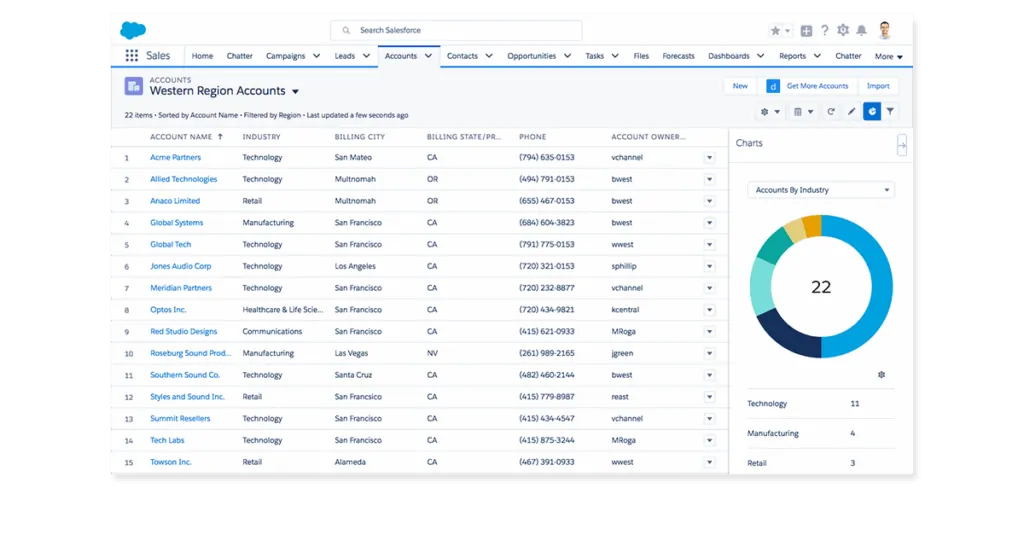
CRMs such as Salesforce help you organise customers by sector and other parameters.
- Identify common traits: from the analysis of your best customers, try to pull out recurring patterns. Are there characteristics your best customers share? You might find, for example, that most of them are in the same sector, that they all fall within a certain turnover range, or that they faced similar problems before adopting your product. These shared elements are important clues: they describe what sets the ideal customer apart.
- Do additional market research: to complete the picture, carry out external research. Study sector trends and competitors: find out what kinds of companies are already adopting similar solutions and where needs are not being met. If you have no internal data (a new business), skip the first steps and start building your ideal profile from here (you can refine it once you have your first customers).

- Define the detailed ideal profile: based on the data and insights collected, write down your Ideal Customer Profile formally. List every characteristic an account must have to fit the ideal profile (sector, size, location, situation, needs, etc.). The more specific, the better. Involve your internal teams to validate it (marketing and sales should confirm it reflects the customers worth going after).
- Share and update the ICP: once defined, document the ICP clearly and share it with the whole team (marketing and sales should always have it to hand). Also plan to update it regularly: for example, review it every year so you can adjust the criteria if the market or your strategy changes, and in light of the new data you collect on new customers.

Following these steps, you can build an accurate Ideal Customer Profile based on concrete information rather than vague hunches. Only by using real data can you be sure the profile is genuinely useful and can serve as a basis for your decisions.
So, with the ICP in place, what comes next? Let's look at how to put this information to work.
How to use the Ideal Customer Profile in marketing and sales
Defining the ICP is only the starting point. You then need to use it in day-to-day marketing and sales. Here are some ways the ICP should guide your strategy:
- Lead qualification: use the ICP as a filter to assess new incoming leads. If a contact does not meet the core criteria of your ideal customer (e.g. the company is in a sector or of a size well outside your target), you might decide not to invest in it.
- Campaign targeting: let the ICP steer your lead generation campaigns. For example, in LinkedIn Ads or Google Ads campaigns, target only companies and roles that match the ICP. In outbound activity too (events, emails to lists), concentrate on prospects that fit the ideal profile.

In LinkedIn Ads you can set the attributes of your audience (based on your ICP data).
- Tailored messaging: when you know the ideal customer's needs, challenges and goals in detail, you can adapt the tone and content of your marketing message to match. For example, create content (blog posts, case studies, webinars) that tackles the challenges of that ICP head-on, and build sales pitches around specific problems.
- Pipeline prioritisation: salespeople should use the ICP to prioritise their pipeline. Especially when they have a lot of leads to handle, it is better to work first on those that best match the ideal profile (they are more likely to convert quickly and bring high value) and put the others further down the list.
Best practices for an effective ICP
To get the most out of your Ideal Customer Profile, keep these tips in mind:
- Identify the key pain points: when you define needs and challenges in the ICP, pick out the critical ones your solution solves best. Don't stop at generic characteristics (sector, size): highlight the specific problems that push a company to look for your product. These pain points are essential for prospecting and will then sit at the centre of your messaging.
- Be specific: a common mistake is drawing an ideal profile so broad that it covers almost any potential customer. Do that and your ICP is useless. Narrow it down to the genuinely best-fit cases. If you find this excludes many current or potential customers, consider creating several ICPs for different segments instead of just one.
- Update it regularly: your ICP should not stay fixed. The market changes, and so do your offer and strategy. Schedule regular reviews of the Ideal Customer Profile (for example every year, or whenever you launch a new product) to make sure it still reflects your best customer. Add new data and remove criteria that are no longer relevant.
Following these practices, you avoid the main traps (such as working on incomplete data or keeping a static profile that is out of date) and make sure your ICP stays a live, useful tool for guiding decisions.
ICP example
To make this more concrete, here is a simplified ICP example. Suppose your company sells CRM software for small and medium-sized businesses. A possible Ideal Customer Profile could be:
- Type of company: SME in the technology or professional services sector.
- Size: 50-200 employees; annual turnover of roughly £5-20 million.
- Needs: better customer management and an automated sales process (pipeline) to work more efficiently.
- Current challenges: uses manual or disconnected tools (e.g. Excel spreadsheets) to manage contacts, leading to inefficiencies and missed opportunities.
- Technical criteria: already has basic IT infrastructure but no CRM in place so far (so it is open to adopting a SaaS solution).

The aim is a profile that describes your best-fit customer. Remember that every business has its own ICP, and that you should add every detail you consider relevant, as we have seen so far.
From ICP to lead generation, Visilay can help
A well-defined ICP is the basis for pointing your effort at the right companies. Especially if you are just starting out and have gathered data through market research (rather than first-hand data), it can be hard to describe your ideal customer in detail. If you are not sure where to begin, we at Visilay can help you define your ideal customer's pain points, carry out thorough market analysis and build a lead generation strategy that works.
