
Key points
- AI keyword generators use artificial intelligence to find high-impact long-tail keywords faster than manual research.
- These tools speed up keyword discovery, adapt to algorithm changes and analyse search intent, so you get SEO insight sooner.
- Free and paid options such as Ahrefs and Semrush help marketers find relevant, high-performing keywords.
- AI keyword generators save time, help you find profitable keyword opportunities and keep you ahead of competitors with data-based decisions.
- To get the most from them, use AI-generated keywords across your SEO campaigns, content and ads for consistent omnichannel visibility.
What is an AI keyword generator (and why use one)? An AI keyword generator (AI) is a tool that uses artificial intelligence to find high-impact keywords for search engine optimisation (SEO) based on what people search for and how they search for it. It saves hours of manual research, uncovers long-tail keyword opportunities and helps you keep up with constant algorithm updates.
Struggling to find keywords that actually rank? If you still spend hours in spreadsheets and keep ending up with the same terms, it is time to rethink your approach.
An AI keyword generator automates the heavy lifting, handling tasks such as:
- Suggesting high-potential keywords
- Surfacing long-tail phrases you had not thought of
- Adapting to search engine updates as they happen.
These keyword generators use AI for SEO to spot trends, analyse intent and give you insights you can use straight away.
In this guide you will see exactly how AI keyword generators work, why they outperform traditional methods and how to use them to simplify keyword research with AI. We cover:
- Ahrefs' free AI keyword generator
- The best AI keyword generators (free and paid)
- Proven AI keyword research prompts
- How AI keyword generators for SEO work
- The benefits of using an AI keyword generator
- How to get the most from your keywords
- FAQs about AI keyword generators.
Ahrefs' free AI keyword generator
Don't want to pay for a keyword generator? You don't have to. Start with free keyword research tools. These generators give solid results at no cost: ideal when you need quick inspiration, quick validation or long-tail keywords in a few seconds.
Free keyword generator
How to use it:
- Enter a topic or your main keyword.
- Choose your country.
- Click "Find keywords".
- Copy, refine and apply them to your content strategy.
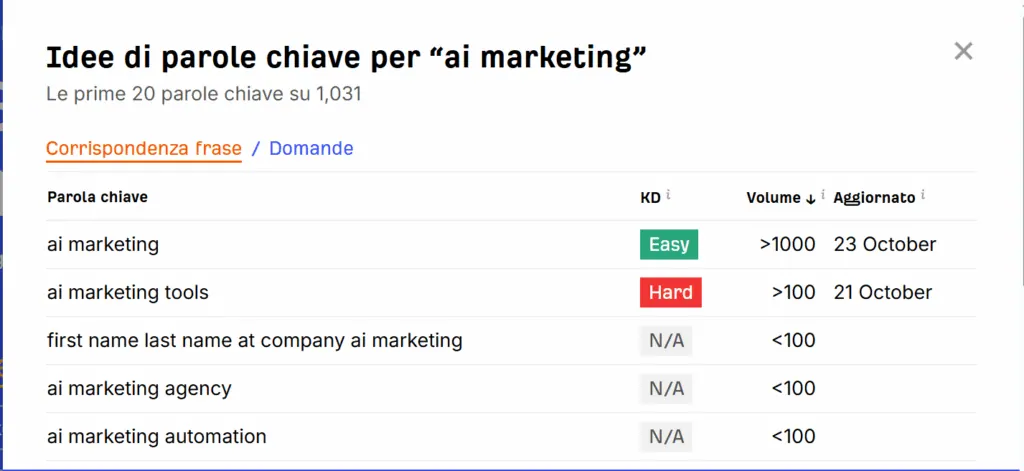
Need keyword ideas for several platforms? Ahrefs pulls keyword suggestions from Google, Bing, YouTube and Amazon, which makes it a good fit for search optimisation work across channels.

To use it:
- Select the search engine you want to research.
- Type your main keyword and select the country.
- Explore the suggestions for each search engine.
Free AI tools for keyword research like these give you a quick, effective starting point for blog posts, ads, product pages and more.
The best AI keyword generators (free and paid)
Whether you are starting from scratch or feel stuck with basic tools, scaling your SEO means going deeper. These AI platforms do that: they offer advanced features such as keyword analysis, search intent mapping and competitor analysis, so you can replace guesswork with data.
These are the best AI keyword research tools for different needs and budgets:
| Tool | Pricing | What it offers |
| RyRob's keyword tool | Free | Helps bloggers find low-competition keywords with search volume estimates and includes a free SEO checklist. |
| Copy.ai keyword generator | Freemium | Generates keyword suggestions and matching content prompts, useful for blog posts, product pages and ad copy. |
| Ahrefs Keywords Explorer | $29+ a month | Gives detailed keyword metrics such as difficulty scores, traffic estimates, SERP features and click potential, with AI assistance. |
| Neil Patel's Ubersuggest | Freemium | Offers keyword ideas, SEO difficulty, competitor analysis and backlink insights, with added AI features. |
| LogicBalls keyword generator | Free | Suggests keyword variations, modifiers and use-case ideas tailored to your input. |
| ChatGPT + extensions | Freemium | Generates creative, conversational keyword lists and clusters from custom prompts. |
| Semrush Keyword Magic Tool | $139.95+ a month | Supports keyword research with filters for search intent, SERP features, question keywords and topic clustering. |
Need more? These are not the only AI tools available. See more AI SEO tools to refine your strategy.
Proven AI keyword research prompts
Can ChatGPT generate keywords? Yes. It is not a keyword tool in the traditional sense, but AI tools such as ChatGPT, Google Gemini and Perplexity can generate keyword ideas, reveal search intent and suggest content angles when used properly.

But don't just type anything and hope for the best. The useful output comes when you ask targeted questions that steer the model towards relevant data. Below is a short manual for turning mediocre prompts into good keyword research tools.
Quick prompt-writing tips
| Tip | Why it matters |
| Specify the content format you are going to create | Tell the AI tool whether you need keywords for a blog, video, product pages or PPC, so it narrows down the results. |
| Include the target audience and intent | Add qualifiers such as "for beginners", "to increase sales" or "informational intent" to refine the suggestions. |
| Ask for variations | Ask for synonyms, questions and modifiers to build larger clusters. |
| Set a quantity and a difficulty | Example: "List 15 low-competition keywords..." so you control the size and complexity of the output. |
| Mix topics and seed terms | Combining broader topics ("AI marketing") with seed keywords ("tools") brings out even more ideas. |
A quick formula that works every time
| Suggest [number] [modifier] keywords about [topic] for a [content format] aimed at [audience/intent] |
Example: "Suggest 12 FAQ-style keywords about AI tools for a SaaS blog aimed at marketing managers".
Try these formula-based prompts:
- "Suggest 10 long-tail keywords related to [topic] for blog posts."
- "Suggest 7 high-converting keywords for a landing page aimed at [audience/intent]."
- "Suggest 15 low-competition keywords about [topic] for a YouTube video."
- "Suggest 8 trending keywords for a podcast episode aimed at [industry professionals]."
- "Suggest 20 informational keywords about [topic] for a knowledge base article."
Or write your own custom prompts:
- "What are the most common questions people ask about [topic]?"
- "Show keyword variations for '[product or service]' for different audience segments."
- "Group keywords by search intent (informational, commercial, transactional) for [topic]."
- "Give me low-competition keywords for [industry] aimed at beginners."
- "Analyse the search intent behind '[keyword]' and recommend 5 related modifiers."
How AI keyword generators for SEO work
What sets AI keyword generators apart from traditional tools? How they work. Traditional keyword research tools rely on static databases and metrics.
AI keyword generators, on the other hand, adapt in real time. They run AI-driven keyword analysis to detect trends, search intent and semantic relationships.
This is how AI SEO keyword generators typically work:
- They use machine learning to analyse huge datasets (search engines, forums, social media).
- They then predict which keywords match the user's intent.
- Finally, they suggest keyword groups and related terms to build topical authority.
AI keyword research tools like these give sharper insights and faster workflows than their traditional counterparts.
The benefits of using an AI keyword generator
Many competitors still rely on outdated tools and gut feeling. SEO today needs precision. AI keyword generators give you an edge by providing data-based insights, uncovering long-tail keyword opportunities and improving your understanding of what your audience is actually searching for.
Here are five reasons AI keyword research is better and faster than traditional tools for high-intent traffic:
| Benefit | What it means in practice |
| Saves hours of research | AI does the heavy lifting by analysing millions of queries instantly. |
| Finds profitable long-tail keywords | You get niche, high-intent phrases that are easier to rank for. |
| Improves content performance | Targeting AI-suggested terms increases visibility and relevance. |
| Adapts to search engine changes | AI tools learn from algorithm changes, so your strategy keeps up. |
| Keeps you ahead of competitors | You can act on data-backed keyword opportunities others have not found yet. |
How to get the most from AI-generated keywords
A list of AI-generated SEO keywords is only the start: what matters is how you use it. Here are the most effective ways to put these keywords to work in your SEO strategy, paid campaigns and content marketing.
Proven ways to apply your AI keyword list:
| Use case | How to apply it |
| Content creation | Use keywords naturally in headings, title tags, meta descriptions and body copy. |
| SEO optimisation | Optimise your URLs, alt text and internal links with the keywords you have chosen. |
| Paid campaigns | Use keyword insights to refine ad copy and targeting. |
| Performance tracking | Track rankings, collect performance data and improve over time. |
| Omnichannel SEO | Apply a consistent keyword strategy across all platforms (web, YouTube, social and so on) |
AI-generated keywords are part of the wider use of AI in digital marketing, helping marketers align content, ads and outreach with real-time search intent. Used across several channels at once, they help unify messaging, refine targeting and get better results.
FAQs about AI keyword generators
More on AI keyword generators in these FAQs:
1. What is the best AI keyword generator?
The best AI keyword generator depends on your goals. For quick, free suggestions, tools such as Ahrefs' AI keyword generator are a good starting point. For deeper insight, paid platforms such as Ahrefs, Semrush and Copy.ai offer more advanced features such as keyword clustering and intent mapping.
2. Can ChatGPT do keyword research?
Yes. It is not a dedicated keyword tool, but ChatGPT can generate keyword ideas, long-tail variations and even keyword clusters if you use the right prompts. It works particularly well as part of a wider AI keyword research strategy.
3. Is there a free AI keyword research tool?
Yes. Ahrefs' AI keyword generator has a free version that gives keyword ideas without needing to log in. Other free tools such as LogicBalls are also good for getting started.
4. How do AI keyword generators work?
AI keyword generators use machine learning and natural language processing (NLP) to analyse huge datasets from search engines, forums and content platforms. They surface keywords based on trends, user intent and semantic context to help you find what people are really searching for.
5. Why should I use AI for keyword research?
AI simplifies the whole keyword research process. It saves time, adapts to search algorithm changes and uncovers hidden opportunities. Using AI for keyword research gives you an edge and helps keep your content relevant and easy to find.
Improve your keyword strategy with AI
AI keyword research is already part of everyday SEO work. We have covered everything from free tools and quick tactics to advanced keyword research techniques, and the conclusion is simple: AI keyword generators have become a standard part of a modern marketer's toolkit.
If you want to stop relying on static data and start using keyword insights that make a difference, the next step is to work with specialists. Our AI SEO services and AI-based platform make it simpler to plan, optimise and develop your keyword strategy.
You have the vision; we have the experience to help. Contact us and let's use AI to work faster and more effectively for your business.
