
Autotrader is searched 5,000,000 times a month in the UK. The domain autotrader.co.uk ranks for 300,946 keywords, 65,766 of them in first position. No dealership will ever compete on "used cars", which gets 110,000 searches a month (DataForSEO, Google UK, September 2026).
In the car sector, online sales belong to the portals, but servicing and repairs are still a local market where an independent garage or tyre shop can win. "Garage near me" gets 201,000 searches a month, "tyre shop near me" 135,000, and the answer to both is a map, not a marketplace.
Below: the split between the two markets, the seasonality that tells you when to push, and what it takes to get into the local pack.
Two markets, two sets of rules

On one side, buying and selling, where the portals have volumes no dealer site will reach. Autotrader has an estimated 19.1 million organic visits a month from Google UK, and the brand search alone runs at 5 million. A click on these searches is cheap, £0.12 on "autotrader" and £0.67 on "used cars" (DataForSEO, Google UK, September 2026; CPC converted from USD at £1 = $1.3242), because the traffic is huge and poorly qualified.
On the other side, servicing and repairs, where people search by proximity: "garage near me" 201,000 searches a month, "mot near me" 110,000 at £2.84 a click, "mechanic near me" 74,000, "car body repair london" 480 at £2.02, "car dealership london" 2,400 at £1.76 with high competition.
The first page for "car mechanic london" confirms it. At the top, a carousel of five directories (Checkatrade, Yell, Bark, TrustATrader, Gumtree). Then a local pack with Auto King Bethnal Green (4.9 from 719 reviews), London Motor Sports (4.3 from 1,500) and a mobile mechanic with 2 reviews. Below that, ClickMechanic and WhoCanFixMyCar, and then the sites of actual mechanics: mobilemechanic.london, nazmobilemechanic.co.uk, islingtonautoservice.co.uk. Independent garages are there, on their own page.
One British quirk to keep in mind: "garage" means both a repair shop and a car dealer. On "car garage leeds", after the local pack of three workshops, the organic results are almost all dealers (Evans Halshaw, JCT600, Autotrader's dealer directory, Brooklands Motor Centres). A garage page that says "servicing", "MOT" and "repairs" in the title tells Google which of the two it is.
Which signals really count in local rankings, in forty-five seconds: Whitespark's 2026 survey of 187 factors.
The MOT and tyre calendar

Seasonality in this sector is the most predictable of all, and hardly anyone builds the year's plan around it. You can check it in two minutes on Google Trends, comparing five years of the same term.
In the UK the calendar is set by the MOT. "Mot near me" runs at 90,500 searches in a normal month and rises to 135,000 in March and again in September and October. New registration plates come out in March and September, the two months when most new cars are registered, and a car's first MOT is due three years after registration. "Car service cost" follows the same pattern: 4,400 searches in September 2025 and 3,600 from January to March, against 2,400 over the summer.
Tyres behave differently. "Tyre shop near me" barely moves, between 110,000 and 135,000 all year, because in the UK people change tyres when they wear out or puncture, not by season. "Winter tyres" is the exception: 1,300 searches a month in summer, 18,100 in November 2025 and 27,100 in January 2026, on the first cold snaps.
Three distinct moments, three different services, three pages to have ranking a month in advance. An MOT campaign switched on in mid-March arrives after half the customers with a March-plate car have already booked somewhere else.
Price searches are the ones that bring in work
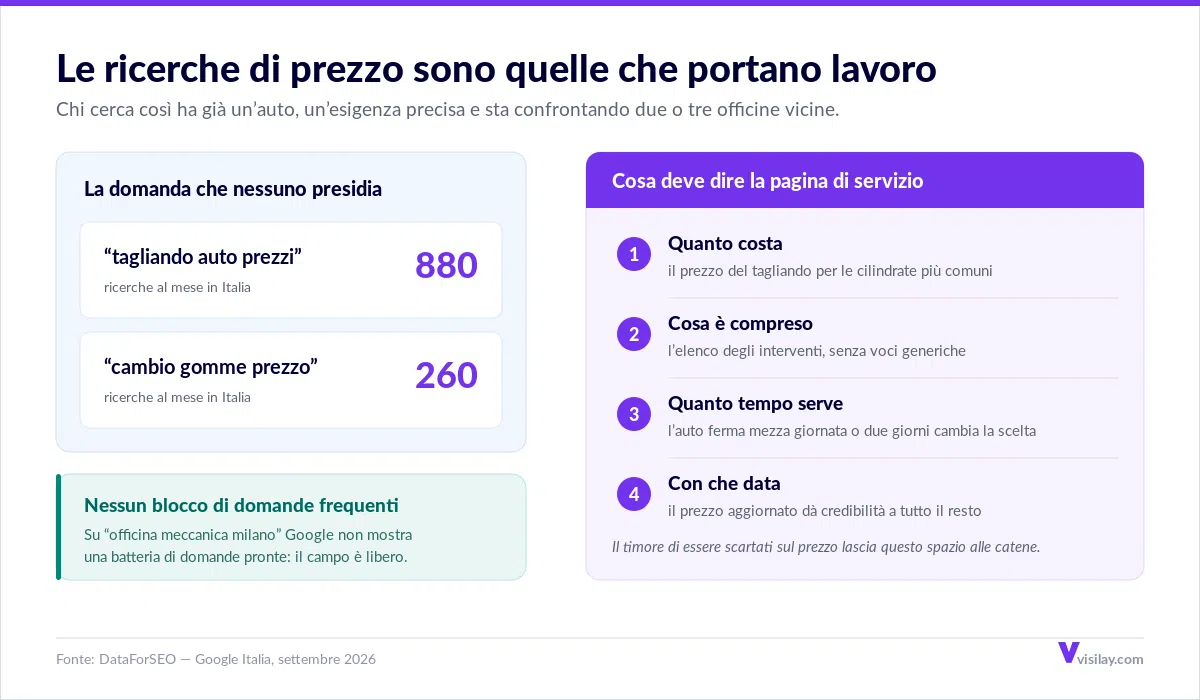
"Car service cost" gets 2,900 searches a month, "full service cost" 1,900, "car service price" 1,300, "tyre fitting cost" 390. Someone searching like this already has a car, a specific need, and is comparing two or three garages nearby.
These are also the searches that garage websites almost never answer, for fear of being ruled out on price before they can explain. The chains do answer them: on "car mechanic london", the RAC ranks with "Full car service in London from just £229" and WhoCanFixMyCar with an average repair price of £250.32 in its snippet. A page that says what a service costs for the most common engine sizes, what is included and how long it takes, with the date, puts an independent garage in the same comparison.
Google confirms the demand. The same SERP has a "People also ask" box that opens with "How much is a car mechanic per hour in the UK?" and "Are mobile mechanics cheaper in the UK?". Price is the question people ask, and a garage that answers it on its own site has something to rank with.
How to set up keyword research and the page structure for a garage, step by step (with chapters).
For a garage, the Google profile is the website
The three garages in the Leeds local pack have 671, 598 and 94 reviews, rated between 4.6 and 4.9. In London the top two have 719 and 1,500, but the third place goes to a mobile mechanic with 2 reviews that is simply closer to the searcher. The leaders are out of reach in the short term; the third slot is not.
For a business that sees dozens of customers a week, getting to a hundred reviews is a matter of months and a request made when the keys are handed back. It is the intervention with the best ratio of cost to result in the sector, and it needs no website at all.
A practical strategy for getting customers to leave reviews, explained in two and a half minutes.
The rest of the profile counts as much as the reviews: services listed one by one (MOT, servicing, diagnostics, tyres), real opening hours including Saturday, and photos of the workshop rather than stock images of engines.
Recommended reading: the guide to local rankings on Google.
Frequently asked questions
Can a dealership do without the portals?
Not if it sells used cars: that is where the demand is, and the portals' numbers leave no alternative. It can, however, work on what the portal does not cover, meaning aftersales, servicing and local trust, which are also the lines with the best margin.
Is Google Ads worth it?
On local searches, yes: with clicks between £1.20 and £2.80 and a job worth a few hundred pounds, the numbers add up easily. On buying and selling searches, no: you are competing with portals that have bigger budgets and better conversion rates than yours.
Does a garage need a website?
It does for service and price searches, where the Google profile on its own is not enough. For "near me" searches the profile is sufficient, and that is also where the biggest volume is.
No, stuffing keywords into the profile description does not push you up the rankings: Darren Shaw explains why in a minute.
How much does listing the makes you work on matter?
It matters, because many searches combine the service with the make and are not very contested. A page for each make you genuinely work on, saying which services you can carry out without affecting the manufacturer's warranty, reaches people who own exactly that car.
When should you push?
February to March and August to October for MOTs and servicing, November and January for winter tyres. Tyre fitting and repairs are steady all year, so they suit an always-on budget rather than seasonal bursts.
Where to start
Search "garage near me" or "mot near me" on a phone, standing outside your business. If you are not in the top three, look at how many reviews the ones that are have. In both cities we checked, the third place was held by a business with fewer than a hundred: a number you can reach before the next March plate change. If you would like an opinion on how to set up your service pages, get in touch.
For those who want to go deeper: proximity, relevance and prominence applied to garages and body shops.

