
In the time it takes to read this sentence, artificial intelligence has analysed millions of interactions with consumers, optimised thousands of ad placements and generated hundreds of variants to serve personalised ads.
It is no surprise that more than 50% of advertisers in South America, North America and Europe say they already use AI to generate content drafts. AI-driven advertising helps companies gain a competitive edge by personalising ads, automating repetitive processes and keeping customer acquisition costs down.
Putting AI to work in advertising is also easier than it used to be. Many of the platforms you advertise on, such as Google Ads and Meta Ads, have built AI tools into their systems to optimise ad placement, budget, targeting and delivery.
This guide covers what you need to know to use AI in advertising effectively:
- What is AI advertising?
- Use cases for AI advertising
- Pros and cons of AI advertising
- Examples of AI advertising
What is AI advertising?
AI advertising uses automation and machine learning tools to make ad campaigns more efficient and more personalised. Machine learning analyses large amounts of data and identifies trends and patterns that can be used to improve campaign performance.
It is like having an advertising team that works 24 hours a day, 7 days a week, analyses millions of data points in seconds and keeps learning from patterns, customer behaviour and industry trends to improve your campaigns.
AI advertising is about more than automating what people already do. It also does things people cannot do at scale, such as making thousands of micro-optimisation decisions on ads in a few seconds.
Use cases for AI advertising
This section covers the most significant uses of AI in advertising, beyond the most common one, generating ad content, and the ways they can help you increase return on investment (ROI).
1. Ad targeting and segmentation
Successful campaigns depend on reaching the right audience precisely: the people most interested in your products and services. Effective targeting means better campaigns, better use of resources and more engagement.
AI extends targeting and segmentation, helping you find new high-value audience segments outside the audience you defined. AI-based targeting works because it predicts purchase intent and user behaviour with more accuracy.
Machine learning enables location-based targeting that takes travel patterns into account. It also supports predictive segmentation, splitting the customer base into distinct segments according to signals such as current location, demographics and interests.
2. Ad personalisation
AI can process thousands of data tokens per second, which means it can analyse huge amounts of data, including purchase patterns, social media activity and browsing history. Digital advertisers can use what they learn from this data to predict behaviour, preferences and trends and build highly personalised ad content.
With AI you can predict which content, products and services suit each segment best. That lets you put your ad spend into the ads that generate most revenue, by giving customers more relevant experiences.
This makes advertising predictive rather than reactive: you make decisions based on the expected outcome instead of adjusting them to live results, as in traditional advertising.
3. Budget allocation and bid optimisation
Machine learning helps automate the buying and placement of ads, with real-time bidding and placement across several platforms and ad channels. It helps you place bids more efficiently and at scale.
When it comes to choosing AI platforms for budget allocation and bid optimisation, you have two options.
The first is to use the AI tools built into the platforms themselves, such as Meta Advantage+, which spreads your budget across different ad sets on Meta platforms such as Facebook and Instagram. This helps maximise campaign performance and lower costs. You can also use Meta Advantage+ to target different channels and reach your goals more efficiently.

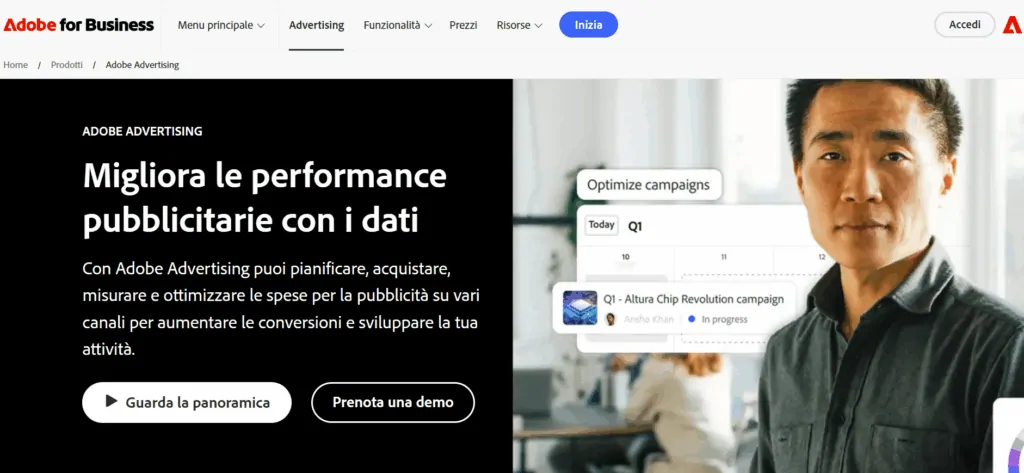
The second is to use third-party AI platforms such as Adobe Advertising Cloud, which help simplify and strengthen media buying and optimisation across several channels, including search and social media.
4. Generating ad content
Content generation is the most widespread use of AI in advertising. Around 40% of marketers already use AI to generate various kinds of content, including video and images. AI is used to develop ads tailored to the target audience and adapted to different platforms.
These are the types of ad you can generate with different AI tools:
- Copy and captions: there are thousands of AI writing tools, such as ChatGPT and Jasper, that you can use to generate content, headlines, ad copy, CTAs and social media posts. Combined with AI SEO services, these tools analyse the brand's tone of voice, audience intent and product features so that the copy fits your audience.
- Images: up to 16% of American Millennials and Gen Z find AI-generated images appealing. You can use Adobe Firefly to create custom AI visuals and graphics for your target audience, and tools such as Canva Pro to remove backgrounds and improve image quality.
- Video: Lumen 5 and Pictory are examples of AI tools used to generate video ads. They can produce good-quality videos in minutes, saving on the cost of crews, actors and editing software.
Always review AI-generated ad content to check its accuracy and its fit with your brand values, and to add a human touch.
5. Ad performance monitoring
Stop guessing which variables matter most. Let AI run thousands of experiments to find the real drivers of campaign success. It automates data analysis, making it easier to adjust campaigns in real time to maximise performance and ROI.
AI removes the errors and inaccuracies of manual reporting and automatically identifies which strategies work and which can be changed or dropped to improve performance. With AI-based performance monitoring you can see what is happening in your campaigns, why it is happening and how to optimise for better results.
AI tools also help you go beyond basic advertising KPIs, identifying micro-metrics such as dwell time and using data modelling to improve attribution.
Pros and cons of AI advertising
AI gives marketers tools for automation, optimisation and personalisation. As with any technology, though, adopting AI in advertising has advantages and disadvantages.
Knowing the pros and cons will help you decide how and where to use AI in your campaigns.
Advantages of AI advertising
Some reasons AI in advertising is worth exploring:
- It automates time-consuming advertising tasks, such as budget allocation, ad content creation and performance monitoring
- It enables optimisation of campaigns in real time, rather than waiting for a campaign to end before adjusting budgets, bids and placements
- It forecasts the performance of upcoming campaigns through predictive analysis of historical data and behavioural signals
- It optimises budgets by reducing human error in planning and strategy, replacing guesswork and cutting wasted spend.
Disadvantages of AI advertising
AI has some limitations that make some marketers reluctant to adopt it in their advertising strategies:
- Data privacy: there are concerns about privacy and data protection, because AI collects and analyses large amounts of company data.
- Bias and inaccurate data: AI tools are limited to the data used to train their models, which often leads to inaccuracies and distortions that reflect developer bias and social inequalities.
- Lack of context: AI tools are still learning and sometimes miss contextual cues, producing errors and ads that feel generic or off-brand.
Examples of AI advertising
Many brands, including international ones, have started using AI in advertising. Some of the best known, worth studying when building your own AI advertising strategy, are:
Nike
In August 2022 Nike launched an AI-based campaign called "Never Done Evolving" to celebrate Serena Williams's career. The campaign used AI to generate two different versions of her playing each other: one from her first Grand Slam in 1999, the other from the 2017 Australian Open.

The simulated match was streamed live on YouTube. Nike says it was its most-watched organic YouTube video at the time, and the project generated more than 130,000 games and 5,000 matches between the two versions of Serena.
BMW
BMW has also brought AI into its advertising, using AI tools to generate artwork for its vehicles.

So far the artwork has been projected onto the BMW 8 Series Gran Coupé to reach the brand's target audience. Goodby, Silverstein & Partners, BMW's advertising agency, also uses AI for predictive analytics and content personalisation at scale.
Read next: AI marketing: use cases, examples and best practices
Build AI into your advertising strategy
Now is a good time to adapt your advertising strategy to include AI tools. Beyond using AI tools for advertising, you also need your ads to appear across every channel, which is where an agency that can support multichannel strategies with AI services helps.
Get in touch to find out how we can help you set up AI-driven ad campaigns.
