
An SEO specialist is someone who knows, and can apply in practice, the techniques used to optimise websites for search engines.
What is SEO?
Search Engine Optimisation (SEO) covers all the work aimed at getting a website crawled, analysed and understood as well as possible by search engines, so that it ranks higher in the SERPs (Search Engine Results Pages).
Below we look at the skills an SEO specialist needs, what the job involves day to day, which tools they use, how to become one, what the role pays in the UK and how to find work in the field.
Who is an SEO specialist?
Digital marketing has plenty of job titles, each with its own area and set of skills, and it is not always easy to tell them apart or to know who does what. In SEO alone there are SEO specialists, SEO managers, SEO strategists, SEO copywriters and SEO analysts (in the UK the entry and mid-level role is often advertised as "SEO executive").
As mentioned above, an SEO specialist handles the technical side of optimising websites so they rank well in search engines. It is a role in steady demand, because a sound SEO strategy brings organic traffic to a site over the long term.
Search engines index billions of pages. Getting a site indexed is not enough: it also has to rank as high as possible in the results, ideally above its competitors.
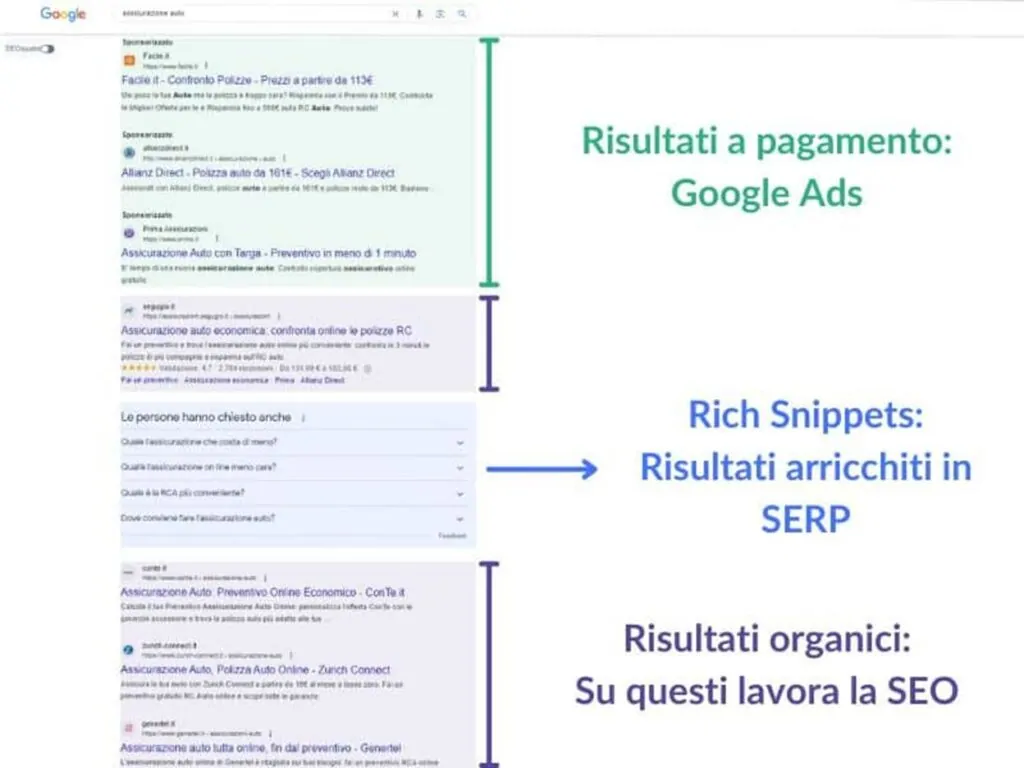
That takes a set of specific techniques, which vary with the goal, the type of site and the business involved.
An example. The strategy for a neighbourhood florist will not be the same as the one for a shoe manufacturer that sells online and ships worldwide.
Every case is different, but there is a common thread: every client who hires an SEO specialist wants more organic traffic from search engines to their site.
Put like that it sounds easy. But for more visits to turn into more business for the client, the people arriving also have to be interested in what the site offers.
What are an SEO specialist's responsibilities?
An SEO specialist's responsibilities depend on the type of working arrangement.
An example. An in-house member of an agency team may own a project entirely or only part of it. A freelancer, on the other hand, is more likely to cover everything the client needs, especially if the client is a small business. The responsibilities change accordingly.
In general, an SEO specialist's responsibilities can include:
- Optimisation strategy. Building a plan of action that improves the site's rankings in the SERPs.
- Running SEO campaigns within the agreed budget.
- Testing and analysis. Checking how the strategy is performing by monitoring results.
- Working with the people who develop the site. Making sure the agreed changes are implemented correctly and on time.
- Working with the creative and marketing teams. Producing SEO-oriented content that fits the marketing goals.
- Link building. A good link building strategy helps the site build authority and, with it, rankings.
- HTML and CSS. A basic grasp of these two languages helps you understand a site's architecture, the hierarchy of information on a page and how its content is formatted.
An SEO specialist works on several levels and across many parts of a website, so their knowledge has to be broad. Here are some of the tasks they are called on to do.
Keyword research
You need to be able to find the best-performing keywords: those with high search volume and low competition. If few indexed pages compete for a keyword, you have a better chance of ranking well for it.
For this analysis you can use online tools (some of them free), which we cover below.
SEO copywriting
That is, writing high-quality website content: blog posts, page copy, product and service descriptions, landing page copy and so on.
A solid command of copywriting helps a great deal in writing text that works for its intended readers and for search engines.
What should you keep in mind when you write SEO-friendly copy?
- Write without grammar mistakes or typos.
- Know the subject well, because the reader is quite likely to know the field already. If you win the reader over, they will stay on the site longer and may share it with friends and colleagues. All of this adds to the site's authority, especially in the eyes of search engines.
- Place keywords correctly in the copy.
- Structure the page hierarchically: split the text into sections, paragraphs and sub-sections, each with a relevant heading.
- Format the text so it is easy to read, keeps the reader's attention and lets them find what they are looking for.
- Add images at the right size (dimensions and file weight in KB) and give them the right attributes.
Graphics
Some graphic design skills help an SEO specialist a lot. You need to know the different image, video and audio formats and how to optimise them.
Most websites carry multimedia content, so you need to know how to make it SEO-friendly.
What makes a successful SEO specialist
These are the traits that set a successful SEO specialist apart.
A thorough understanding of SEO at its three main levels:
- Technical SEO. As we have seen, knowing how a website is built helps improve both the user experience and search rankings.
- On-page SEO. Everything that helps a single page rank well: the content, meaning the text and its heading hierarchy, keywords, multimedia elements and so on.
- Off-page SEO. Building the site's reputation outside the site itself helps rankings. This includes link building, social media activity and similar work.
Digital marketing knowledge. SEO is part of digital marketing, so to get good results you need to understand what drives organic traffic to a site and which actions can increase it.
A broad view. SEO touches many parts of a website. Don't focus only on the blog or on anchor text: start from the domain and the permalink structure and work through to accessibility and usability.
Communication and teamwork. Essential if you want to work in a team.
Finally, to do well in this field you need a solid understanding of how technical SEO affects a site's rankings. You also need to keep up with SEO news and, above all, with changes to Google's algorithm.
What jobs are there for SEO specialists?
As with many digital roles, an SEO specialist can work as an employee or as a freelancer.
- Employee. For example at a digital marketing agency, or in the marketing and communications team of a large company.
- Freelancer. With your own clients and/or working for marketing agencies as an external contractor (usually project by project).
You may take over a site that is already live and have to analyse it to find where rankings can be improved. Or you may be given a project that is starting from scratch.
Either way, you need to assess the current situation and work out an effective strategy. You can do much of the work yourself, since you have the skills. In large organisations, though, there are often specialists already in place and you will have to work with them.
To find work in this field, set up a profile on professional platforms such as LinkedIn.
Who does an SEO specialist work with?
As we said, SEO touches every part of a website, so the specialist deals with everyone who works on it directly, as well as with the people running the project.
In an agency you will mostly deal with the account manager, the person who speaks to the client. Then there are the creative, marketing and technical teams: designers, developers, social media managers, copywriters and so on.
5 reasons to become an SEO specialist
Here are some good reasons to consider a career as an SEO specialist.
- It is a growing field with steady demand for SEO specialists. In the UK, "seo jobs" alone is searched around 1,600 times a month (DataForSEO, Google UK, September 2026).
- You are good with words and can write copy that appeals to a specific audience.
- SEO changes all the time and you enjoy keeping up to date.
- You can see the big picture of the projects you are given.
- Once you have SEO skills, you can specialise further in digital marketing, social media, journalism, consultancy and more.
What does an SEO specialist do?
Now let's look at what an SEO specialist actually does.
An SEO professional's job is to optimise a website so that it ranks higher in search engines and gets more visibility in the SERPs. The work can be split into stages.
When given a new project, the first step is an SEO audit of the site. The audit can be done at different depths, with specialist tools (see the next section). The aim is to check the site's traffic, indexing and rankings for specific keywords, and to find weak points. You can go further and analyse competitors, user behaviour on the site and much more.
Once the analysis is done, you can draw up a strategy, which may include several types of work:
- Fixing existing errors or optimisation gaps.
- Finding further relevant, well-performing keywords.
- Researching topics to cover (for example on the blog) that help build the brand's authority.
Rolling out the whole strategy may take several months, but you should see some results within the first few weeks. Once the first changes are live, the work moves on to ongoing monitoring to track progress.
What are the main tools SEO specialists use?
To analyse a website and track the work done on it, you can use a number of professional tools.
- Google Analytics. The world's most used search engine, with billions of searches every day, gives professionals a very effective tool for free. With Google Analytics you can analyse site statistics in detail, follow marketing campaigns and get useful information about the traffic they generate.
- Google Search Console. Another Google product, with data on indexing, rankings, errors and more.
- Google Ads. Its Keyword Planner gives an overview of a keyword's average searches, how competitive it is and more.
- Semrush. A tool built for digital marketers. As well as site, keyword and competitor analysis, it offers a large library of useful resources.
- Ahrefs. Useful for analysing a website in depth.
- Majestic. A tool focused on backlink data, with its own Trust Flow and Citation Flow metrics.
- Screaming Frog. A very good SEO crawler that analyses a site in depth and flags errors and optimisation gaps.
These are the main tools; the full list would be much longer. Even so, it is clear there are plenty of tools for analysing every aspect of a site.
Does an SEO specialist need to code?
As mentioned, you should know how a web page is structured, meaning how its sections are laid out in the code. So you should have at least a working knowledge of HTML, ideally HTML5. And since most users browse on mobile, it helps to know how a responsive site is built, which means knowing CSS3.
However well a piece of content follows SEO principles, if the site does not meet basic accessibility and usability standards you will never reach your goals.
Many job ads ask for PHP and JavaScript. In my experience you don't need to be able to code, as that is what developers are for. A basic knowledge of these languages does have its benefits, though.
In short, you don't have to be a developer to work as an SEO specialist, but a good grounding in web design is a real advantage.
How to become an SEO specialist
SEO spans several subjects and skills. It is also very technical work that calls for analytical skills, regular reporting and a strategic, goal-driven mindset.
There are several ways to specialise in SEO.
SEO courses
Some university degrees include SEO modules, typically degrees in marketing, digital marketing, communications and similar subjects.
Specialist SEO courses, on the other hand, come in every shape and size.
Since a site can be worked on at several levels and on several fronts, my advice is to take more than one focused course: SEO copywriting, SEO audits, Google Analytics, keyword research and so on.
In the UK, recognised professional qualifications that cover SEO within digital marketing include:
- Chartered Institute of Marketing (CIM): Level 3 Foundation Certificate, Level 4 Certificate and Level 6 Diploma in Professional Digital Marketing.
- Data & Marketing Association (DMA): Professional Diploma in Digital Marketing.
SEO internship
SEO is not an exact science, and if you go into it you will find you learn far more on the job, through experience.
So if you are starting out in SEO, I'd suggest an internship at an agency with senior SEO specialists. It is a good chance to learn from people who know the job.
SEO books
Books on the subject are another way to build your SEO knowledge. Two English-language titles worth starting with:
The Art of SEO (Eric Enge, Stephan Spencer, Jessie Stricchiola, O'Reilly). A comprehensive reference covering strategy, technical SEO, content and measurement.
Product-Led SEO (Eli Schwartz). How to build an SEO strategy around the product and the user rather than around single keywords.
Build a WordPress site
If you can't or don't want to do an internship at a web agency, you can put what you have learnt into practice on a site of your own.
Building a site with WordPress takes very little time, costs next to nothing, and WordPress is the most widely used CMS. If you browse SEO specialist job ads, you will see that most of them ask for WordPress experience.
Working on your own website has several advantages:
- The work is faster, because you skip all the steps that would otherwise involve other people (plus the project lead). If something needs changing, you change it, without waiting for approval or for a colleague to do it for you.
- You have more control over everything that makes a website succeed.
- Hands-on work lets you learn and improve much faster than any other method.
You can also use your site as a CV that shows what you can do as an SEO specialist.
What are an SEO's hard and soft skills?
By now you will have a clear idea of the skills a good SEO specialist needs. Let's put them in order: the essential skills, and the ones worth developing if you don't have them yet.
SEO hard skills: technical and practical abilities
To do this job you need to be able to apply the technical strategies that best improve a site's rankings and so increase its organic traffic.
You get there by analysing the current situation, planning a strategy and applying a set of techniques tailored to that project. Then you monitor results to see whether the strategy works. If results are slow to come, or fall short of expectations, you adjust the strategy.
Hard skills also include in-depth knowledge of the tools needed to analyse every aspect of a site, competitors, keywords and so on.
To sum up:
- All the core SEO techniques.
- The basics of HTML5 and CSS3.
- Ideally, some PHP and JavaScript too.
- Working knowledge of at least these tools: Google Analytics, Google Search Console, Google Ads, Semrush, Ahrefs, Screaming Frog.
- WordPress.
- Many WordPress sites use the Yoast SEO plugin, so knowing how to configure all its settings properly is a big plus.
All of these can be learnt through study and practice.
Among the hard skills I also include analytical and strategic thinking. Analysis tools help you find the information you need, but you then have to interpret it to get any value from it. The tools give you signals; it is up to you to work out what works on the site and what doesn't, how to improve things and which strategies to back to reach the goals.
SEO soft skills: transferable skills
Some other abilities help a lot in doing the job well. Some people have them naturally, but they can also be developed with experience.
Interpersonal and communication skills
In this job you will often have to persuade a prospective client to give you the work. Even more often, you will be part of a team and have to work things out with colleagues all the time.
Whatever the situation, you need to handle discussions, take part in meetings and present your strategies and results. Remember that not everyone is an expert, so language and data must be explained as simply as possible, but convincingly.
This group also includes creativity and intuition. Creative thinking can lead to strategies that no technical data would suggest, sometimes from a simple hunch. Nothing abstract, of course: these are strategic ideas that are still backed by proper technical analysis.
Organisational skills
Web agencies in particular value skills such as:
- time management and meeting deadlines;
- conflict management, reaching a solution quickly that satisfies everyone involved;
- problem solving, meaning finding the best solution to a problem in the shortest time.
Flexibility is often expected too: the ability to adapt to change, which in digital happens all the time.
How much does an SEO specialist earn?
As we have seen, you can do this job in several ways, each with its own advantages, so it is hard to pin down a single figure. In general, the salary of an SEO specialist employed by an agency or in-house depends heavily on responsibilities and seniority. These are the UK ranges published by Prospects (prospects.ac.uk, accessed September 2026):
| SEO specialist | Gross annual salary (UK) |
| Junior (agency) | £24,000 to £26,000 |
| Experienced | £32,000 to £55,000 |
| SEO manager / head of SEO | £38,000 to £56,000, in some roles over £100,000 |
| Freelance | £240 to £320 a day, often more |
Estimating what a freelance SEO specialist earns over a year is much harder. It depends on how many clients you have, what kind of clients they are (a large construction firm, the florist round the corner and so on), how much time you give to the work and many other variables.
SEO specialist jobs (always up to date)
Today most digital job offers are found online. As mentioned, set up a professional LinkedIn profile straight away and turn on alerts for jobs that match your profile. To make the search easier, you can also check the LinkedIn listings for SEO specialist roles regularly.
In the UK, a few other places are worth checking:
- Reed, one of the largest UK job boards, with a dedicated SEO jobs section.
- Totaljobs, which lists SEO specialist and SEO executive vacancies across the country.
- Campaign Jobs, a job board for marketing, media and agency roles.
- Upwork. If you want to freelance, create a profile and check new projects regularly: companies post SEO work there and contact freelancers directly.
Finding work as an SEO specialist
Once you find an ad that matches your skills and needs, you can apply for the role.
Cover letter
It sets out how you present yourself professionally. Even though this is a modern, digital job, avoid a teenage tone. Show that you are serious, precise and able to keep things short.
The main purpose is to summarise your skills (in line with those requested). The letter should also set you apart from other candidates and convince the recruiter that you can be useful to the company.
When writing a cover letter, follow these good practices:
- Read the ad carefully. You need to understand what the company needs to judge whether you can help.
- Research the company. Visit their website, see what they do and whether you have worked on similar things.
- Describe your skills and experience briefly, highlighting those that match the ad.
Some companies also ask why you are applying. In that case, describe your interest in the work and in the company.
Before you send the cover letter, reread it calmly. It must read smoothly and be grammatically correct.
Finally, attach your CV.
The CV
Your CV shows what you know in specific areas. Ideally you would tailor it to each job ad and company, but that is often not practical, so prepare a master CV that you tweak when needed. That does not mean using a ready-made template, which tends to be padded and wastes recruiters' time.
For an SEO specialist, the CV should be:
- Concise. There is no point listing everything you studied on courses or every task you did at work. Include only the skills you gained and the results you achieved (the important ones, of course).
- Well formatted. Present each piece of information clearly and use the formatting your word processor offers: headings and subheadings, bullet points, bold and italics. Use all capitals only for acronyms, never for words or whole sentences.
- Focused on achievements. Use the formula action verb + task + result. For example: I developed a high-quality editorial plan that earned 50 natural backlinks in 4 months.
- Backed by evidence. You can include figures and screenshots from analytics tools.
If you have several skill sets, split them into clear sections.
Overall, the CV should tell your future employer what your career path has been and what you have achieved. Naturally you will focus on successes, but what matters is being honest and not claiming skills you don't have.
Reread it carefully and save it as a PDF.
Some agencies look for someone who will deal directly with clients, so you may be asked to add a photo to your CV.
The job interview
Your application went down well and you are invited to an interview. Many interviews now take place online, on video-call services such as Microsoft Teams, Google Meet and Zoom. So, if you aren't already, get set up with a good connection and a decent webcam (or a smartphone, but on a stand, not in your hand), and practise with these services.
A few tips for an online interview. The interviewer can see what is behind you, so choose a suitable setting. Dress and prepare as you would for an interview in person. Make sure there is no background noise. Silence your phone.
It is normal to feel some nerves before an interview. To go in calmer, rehearse answers to the questions you are likely to be asked. For an SEO specialist role, expect questions such as:
- How do you measure the success of an SEO strategy? Your answer shows your technical SEO knowledge and your ability to work towards goals.
- Which SEO tools do you use regularly to plan a strategy and track results? Google's own tools always go down well; add the others we have covered. They are the most widely used internationally. If you hold certifications for them, even better.
- What kinds of projects have you worked on? You don't need to name the companies. A general description is enough: a shoe e-commerce site, an online learning platform, a consultancy and so on.
- Which strategies did you use and how long did results take? Be as detailed as you can, with charts and numbers.
- What results did you achieve. Talk about your successes, naturally.
You may be asked many other questions, but these are the ones that establish and test your skills. Prepare a short (but complete) account of everything that could convince your future employer to hire you.
