
Digital marketing strategies let a company build its online presence, reach its target audience, generate new leads and, as a result, sell more. With so many channels to choose from, how do you work out where to start?
In this article we have gathered the essential marketing strategies you can start investing in now. Before we get to them, though, let's take a step back and look at why you should plan a strategy before getting to work.
Why do you need a marketing strategy?
Everything we do as a company to promote our services or products falls under marketing. We can split offline marketing from digital marketing; the latter covers channels such as the website, social media profiles, email campaigns and PPC advertising.
A solid strategy behind our digital marketing campaigns is what makes tangible results possible.
Digital marketing in B2B has several benefits beyond increasing sales. Here are the main ones.
- Building brand awareness: marketing campaigns let us develop a tone of voice consistent with our brand and get ourselves known. We need to act with a clear plan, though, so that our message reaches the right audience.
- Targeting the audience: in B2B especially, rather than trying to cover a broad audience, we should focus on a much narrower and more precise target, the slice of the market that is likely to be interested in what we offer.
- Meeting needs as they arise: during a prospect's long decision-making process, we have to reach them with the right content at the right time. That is why, as we will see below, a marketing strategy needs a careful study of the market and of the buying journey.
- Getting measurable results: one of the advantages of digital marketing is that we can set goals and track key metrics as the work progresses.
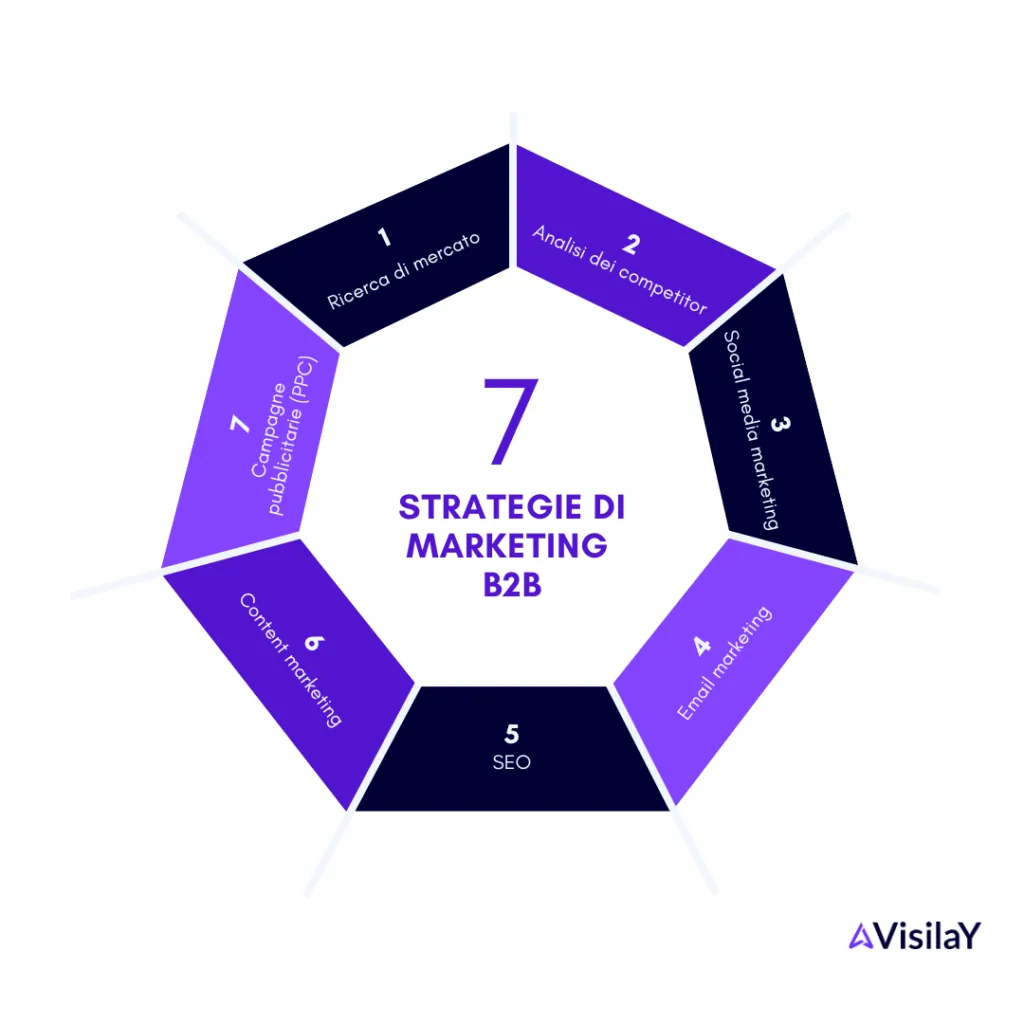
7 essential B2B marketing strategies
Now that we have covered the benefits of having a marketing strategy, let's look at where to start in practice. These are the marketing strategies you should have in your toolkit if you want more sales and higher profits in B2B.
Carry out market research
In B2B, market research should be the starting point for understanding our audience and their needs, so that we can respond to prospects' requests as well as possible.
Market research is essential because it lets us define one (or more) buyer personas, the profiles of our "ideal customer". In B2B, however, this means going deeper and answering more detailed questions, such as:
- Who are the decision makers?
- How are purchasing decisions made in this specific area?
- Which factors carry the most weight in the buying decision?
- How do customers find out about our company?
These preliminary questions can be expanded to build a picture of the market. Later, once the business is up and running, research can also show how our company is perceived by customers (and in general):
- What do customers think of our communications?
- What makes customers come back or stay loyal to the brand?
- How is our brand perceived?
- What sets us apart from competitors?
Besides deciding which aspects to explore, we need to choose the right methodology to carry out market research effectively. There are several methods, and they can be combined.
First, there is primary research, which includes:
- One-to-one interviews: individual interviews let us gather detailed information and build trust with the people we talk to. The drawback is that this kind of research can be expensive in both money and time.
- Surveys: surveys are the best method for quantitative research. A practical example would be using a survey to measure customer satisfaction.
On the other side there is secondary research, which covers everything we can do starting from existing data. A few practical examples of sources:
- industry reports and statistics;
- analysis of online communities (such as social media groups, industry communities or review sites);
- databases or directories of company data.
This kind of research helps us understand the market we operate in, collect data and even build contact lists.
Run a competitor analysis
Primary and secondary market research help us define our sector, the decision makers and the profile of potential customers precisely. Another useful exercise is a targeted analysis of our competitors. Here are some practical pointers to get started.
Identify and segment your competitors
Competitors are not a single category: we need to make some distinctions to understand who all our competitors really are.
Direct or primary competitors: companies in direct competition with us, selling products or services very similar to ours to the same target.
Secondary competitors: companies with an offer similar to ours but a different target.
Tertiary or indirect competitors: companies that do not sell the same product but address the same audience niche. Their products are not the same as ours but are an alternative solution to the same need.
A practical example makes the difference between direct and indirect competitors clearer. For a company that sells books, a direct competitor would be another bookshop in the same area, while an online audiobook platform could be considered an indirect competitor.
Analyse your competitors
Once competitors are sorted into categories, the actual analysis begins. If we want to focus only on their online presence, we can look at the different channels where our competitors are active:
- the website;
- social media channels;
- reviews on specialist sites.
As well as studying our competitors' online image, we should gather information on their sales process. It helps to find out:
- How does their sales process work?
- Which channels do they use to promote their products? And to sell them?
- What results do they get? (Annual turnover, number of clients, etc.)
Last but not least, it is worth studying their marketing strategy to see what they focus on. Some useful starting points:
- Run an SEO analysis of competitors' websites to reverse-engineer their strategies.
- Tools: Similarweb gives us information on traffic to other sites. With tools such as Semrush we can find the most visited pages and the keywords our competitors rank for.
- Study competitors' PPC campaigns.
- Tools: the Meta Ad Library and the Google Ads Transparency Center let us see competitors' paid campaigns (current and past).
Reach customers through social media
A good social media presence is now a must, but being on every channel matters less than being consistent. In B2B the social network of choice is LinkedIn, so it is no surprise that it is the preferred channel for new product launches in 81% of cases, followed by:
- Twitter (now X) 71%
- YouTube 54%
- Facebook 54%.
LinkedIn is also the most used platform for lead generation: according to LinkedIn's own data, 80% of leads from social platforms come from LinkedIn, leaving the other platforms with the remaining 20%. (Source: Bant.io).
Open a direct channel with email marketing
50% of marketers consider email the best marketing tool in terms of return on investment. (Source: Lead Forensics).
There are more and more channels available for digital marketing, but email remains a favourite because of the advantages it brings, including:
- the option to use automation;
- A/B tests that let us keep testing until we find what works best;
- personalised communications based on customer segmentation.
Meet demand with SEO
Most B2B buyers discover new products through search engines. Search is the channel B2B buyers use most (66%), followed by searching on marketplaces (50%) and browsing product catalogues (43%) (Source: Backlinko).
Since searchers tend to click on the top results, to capture those searches and gain organic traffic you need to improve your site's rankings. This is where search engine optimisation (SEO) comes in: it lets us put strategies in place to improve our pages' ranking and so get more clicks and more traffic.
Beyond SEO: content marketing
If we look beyond capturing organic traffic, we can use content marketing to create content tailored to different channels.
This can mean both capturing searches and encouraging prospects to discover our content. For example, we can use our own channels:
- website (as we saw with SEO);
- social media accounts;
- email list;
- YouTube channel.
To build a content marketing strategy, besides choosing the most suitable channel, we can experiment with different content types. Below are the ones used most in B2B.
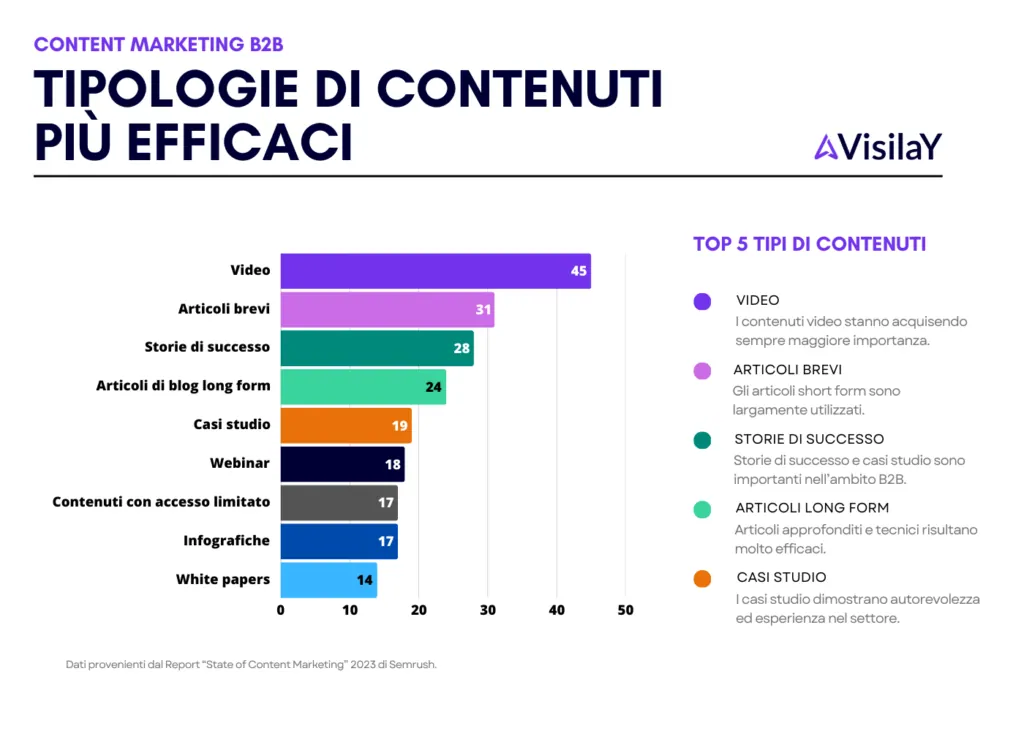
Content should also be structured around the stage our prospect is at. Take a funnel split into:
- Top of Funnel (TOFU): awareness of the problem or need;
- Middle of Funnel (MOFU): evaluation;
- Bottom of Funnel (BOFU): purchase.
You will need content for each of these stages, while also taking into account how competitive each topic is (especially if you want to rank in search engines). According to data reported by Backlinko, 67% of content teams focus on TOFU content (where competition is lower), 27.9% on MOFU and only 4.7% on BOFU.
Invest in ads
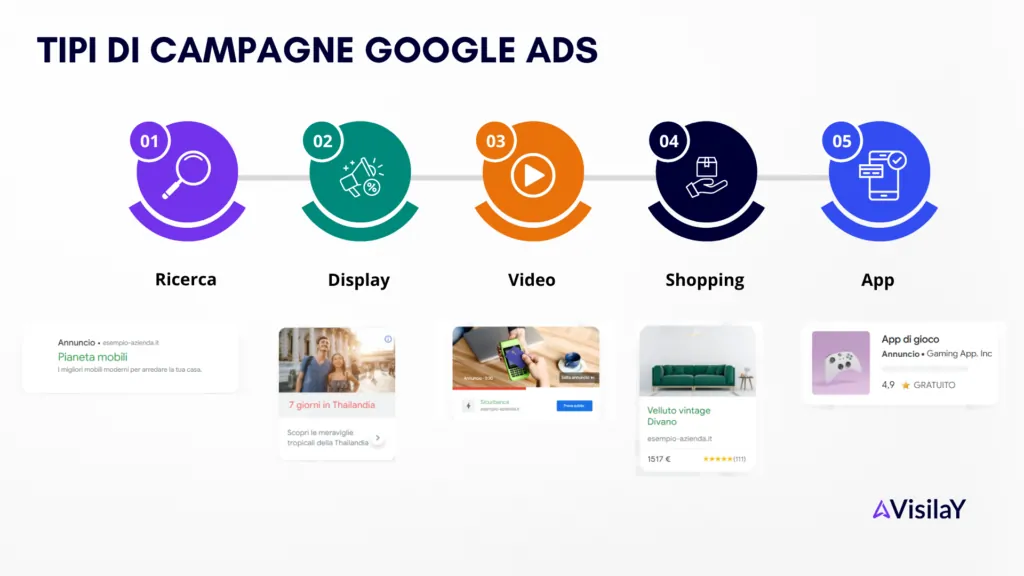
PPC (pay per click) campaigns can be a very effective part of a marketing strategy. With Google Ads you can cover several channels with different campaign types: from search ads shown in the SERP to display ads across partner sites, video, app ads and sponsored listings in Shopping.
Then there are Meta Ads and LinkedIn Ads, which let us run advertising campaigns directly on social media.
Get help with digital marketing from Visilay
A B2B marketing strategy lets us reach prospects during their decision-making process. With content marketing, SEO, social media and email we can both catch customers at the start of their journey (for example while they are researching a topic) and stay with them along the way (for example with nurturing email campaigns).
To get started, the key is working out which strategies to focus on before expanding. If you are planning your first steps or want to move into a new channel, Visilay has a specialist team ready to work alongside you. We can run your Google Ads and LinkedIn campaigns, build or improve your website or help you strengthen your SEO strategy.
