
Want your B2B sales to grow steadily?
Here is how to build a B2B pipeline from scratch, from identifying prospects to closing contracts, with practical advice for small and medium-sized businesses.
A B2B sales pipeline is what makes revenue predictable.
If you run a business or a sales team and want to develop a B2B pipeline that keeps a steady flow of deals moving, this guide is for you.
We will look at what a B2B pipeline is and why it matters for your company, then build one step by step.
You will also find tips from practitioners, common mistakes to avoid and answers to frequently asked questions.
Let's get your pipeline moving.
What a B2B pipeline is and why you need one
A B2B sales pipeline is a visual snapshot of your sales process: it tracks every potential customer as they move from first contact to close. Think of it as a map to follow.
At any given moment, for example, you might have:
- X leads in early conversations
- Y proposals under review
- Z deals close to signing.
This at-a-glance view helps you prioritise prospects and forecast sales.
For an SME, building a B2B pipeline matters because it gives structure to the sales effort.
Instead of hoping leads will somehow convert, you will know exactly:
- which stage each deal is at;
- what to do next to move it forward.
Some benefits of a well-built pipeline:
- Accurate revenue forecasts: a clear pipeline lets you forecast next quarter's sales with more confidence, because it shows which deals are closest to closing.
- No forgotten leads: you will not forget to follow up with a warm prospect, so you stop losing deals to simple oversight.
- Better conversion rates: by guiding prospects step by step, you can spot and fix bottlenecks (if many deals stall at the proposal stage, you know where to act).
Pipeline vs funnel: what is the difference?
You will also have heard of funnels and sales funnels.
A funnel is similar to a pipeline, but it describes the journey from the buyer's point of view (from awareness to decision).
The pipeline describes the process from the seller's point of view: the stages and actions the sales team goes through to take a lead to purchase.
In short:
- Funnel = customer journey
- Pipeline = sales journey
This article focuses on building and managing the sales journey.
Now that we know why the pipeline matters, here is how to build a B2B pipeline in five practical steps.
How to build a B2B pipeline in 5 steps (from prospect to close)
Building a solid pipeline is like building a house: you need firm foundations and a clear plan.
Follow these 5 steps to create a B2B pipeline for your company.
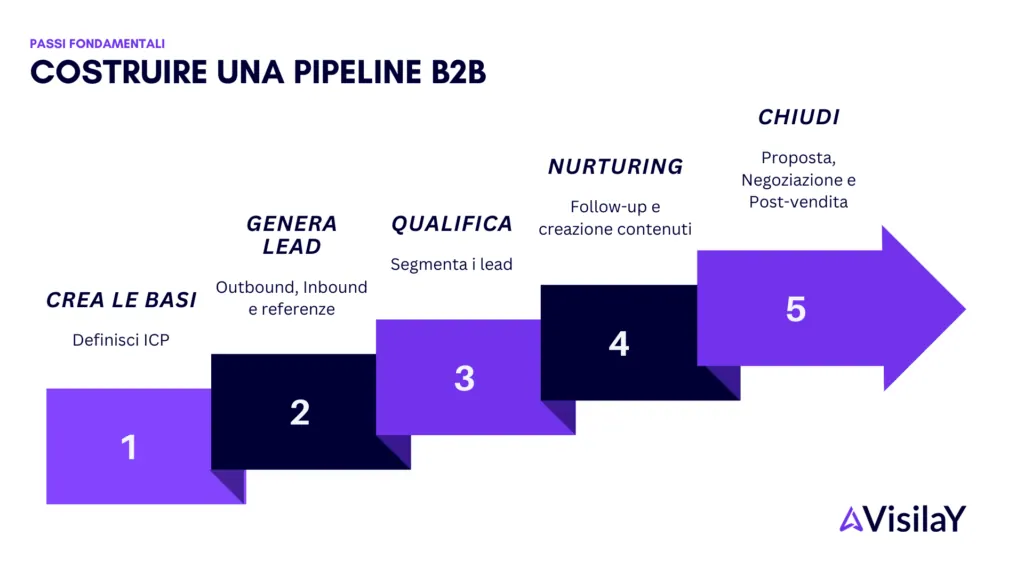
Step 1. B2B pipeline foundations: define your ideal customer and qualification criteria
Every good pipeline starts with knowing who you are targeting and what a good prospect looks like for you.
Start with prospecting by clearly defining your Ideal Customer Profile (ICP). Ask yourself: which clients bring us the most success and satisfaction?
Look at your best clients and note what they have in common:
- Sector
- Size
- Location
- Problems
- Budget
For example:
If you sell B2B software and your happiest clients are tech start-ups with 10-50 employees that need project management tools, that is a key insight for your ICP.
Then set your lead qualification criteria: the conditions that make a prospect worth pursuing.
A widely used framework is BANT: Budget, Authority, Need, Timeline.
In practice you check:
- Budget: can they afford your solution?
- Authority: are you speaking to the decision maker (or to someone who can put you in touch with them)?
- Need: do they have a problem your product or service can solve now?
- Timeline: do they plan to decide soon, or are they just "having a look" for the future?
Defining these factors gives you a "filter" for good leads.
Picture the pipeline stages as gates: only leads that meet the basic requirements go through.
For a small business this focus is valuable: it stops you spending energy on leads that will never convert.
Take action:
Write down the common traits of your ICP and 4-5 qualification questions (e.g. "What is your main challenge with X?", "Does anyone else need to approve this before you go ahead?").
You will need them in Step 3 to assess leads.
Step 2. Filling the top of the pipeline: lead generation
Now that you know your target, it is time to get leads into the pipeline.
The top of the pipeline (prospecting or lead generation) is about finding potential customers and getting their interest.
A small business will probably need a multichannel approach:
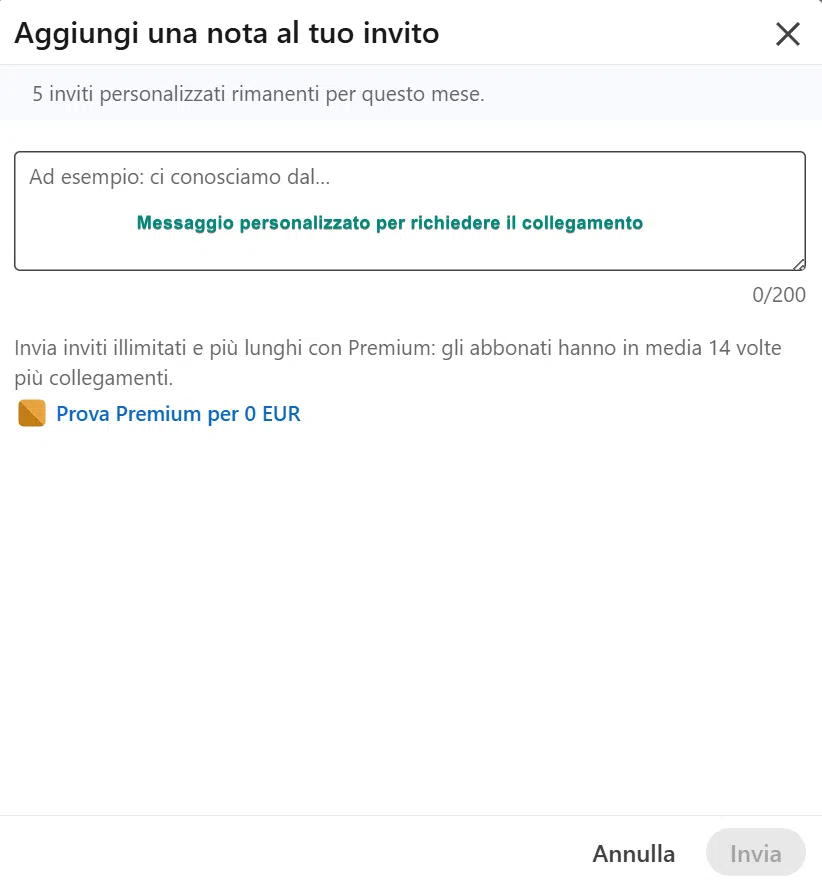
- Outbound prospecting: you contact your targets directly. For example, build a list of companies that fit your ICP and send a personalised email on how you can help them. Or use LinkedIn to connect with decision makers and start a conversation (not a pitch).
Outbound is a proactive process in which you approach companies yourself. It works well for B2B SMEs because it is low-cost and targeted.
(Pro tip: keep messages short and personalised, and mention relevant details about their company so you do not look like spam.)
- Inbound marketing: here, unlike the approach above, you draw leads towards you. It can be slower for a small company, but it pays off more over time.
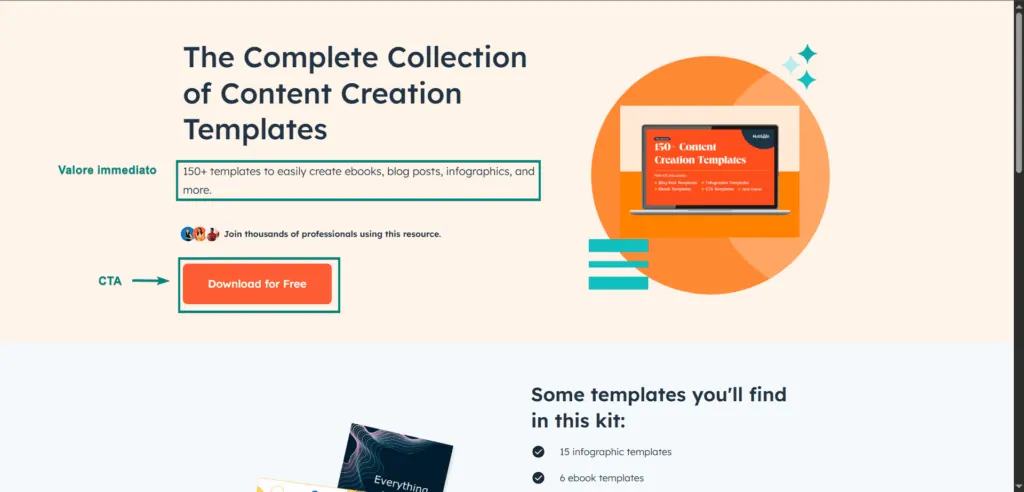
Tactics: invest in SEO with useful blog posts (such as "The top 5 trends in [your sector] 2025"), offer a free guide or webinar, and make your website easy to contact you through (contact form or chat).
The idea is that prospects find your content, see you as an expert and get in touch.
Even a few inbound leads a month can raise the quality of the pipeline, because they are often already "warm".
- Referrals and partners: do not underestimate this source.
Satisfied clients can recommend you to others (sometimes you only have to ask).
You can also set up referral partnerships. For example, you are a web agency working with an IT company: you pass clients to each other whenever one needs the other's service.
Referrals help you close faster and with more trust.
You might also offer an incentive, such as a discount or a small reward, to anyone who brings you new clients.
At this stage the goal is to have plenty of leads entering the pipeline.
But aim for quality leads that match your ICP (the process from Step 1). A few qualified leads are more likely to turn into sales than many unqualified ones.
A practical example of Step 2:
You run a B2B HR consultancy for local manufacturers.
- Outbound: email 30 HR managers at mid-sized companies explaining how you reduce staff turnover.
- Inbound: publish a case study, "How [Client] cut staff turnover by 20%", and share it in a LinkedIn group in your niche, with a call to action for a free consultation.
- Referral: ask current clients whether they know another plant that could use your help (perhaps offering a free on-site workshop if the referral becomes a client).
All these contacts (emails sent, people who downloaded the case study, referrals) enter your pipeline.
Step 3. Keeping the pipeline healthy: qualify and segment leads
You have a good number of leads coming in.
Step 3 is about qualifying them so you can spend your time on the leads most likely to buy.
In practice, you assess each new prospect against the criteria from Step 1 (BANT).
Many CRMs and pipeline tools help with custom statuses, such as "New" or "To qualify".
When a new lead arrives (from an email, the website form, etc.), do not treat it straight away as a live deal.
First run a quick check:
- Does it match your ICP? (Yes = good; No = caution: perhaps not the ideal client, but it may still be interesting if other factors are strong.)
- Have they engaged with you? For outbound: did they reply or book a call? For inbound: did they give complete information or ask explicitly for a demo? Proactive interest is a good sign.
- Are the BANT criteria met? Perhaps on a call you found out they have budget next quarter, or that you are talking to the CEO (authority). Every criterion ticked is a point in their favour.
Based on this check you can segment leads:
- Qualified leads: they show potential (real need, right fit, ability to buy). They move forward in the pipeline for deeper engagement (e.g. discovery call, demo).
- Unqualified leads: for now they do not meet the criteria (too small, no budget, little interest). Do not delete them: keep them in a "Nurturing" or "Cold" list for lighter follow-up over time. They are out of the active pipeline for now.
- Leads to investigate: sometimes you are not sure yet. Keep them as "maybe" and aim to get the missing information (e.g. with a short call and your qualification questions).
Being strict and precise in qualification is what gives you a high-converting pipeline. Better to focus on leads with real potential than to spend time and resources on prospects that are too cold.
Tip:
Create a simple qualification checklist.
Here is an example:
- Do they have a pain point we solve? Y/N
- Is the decision maker involved? Y/N
- Have they mentioned budget? Y/N
- Timing = this quarter? Y/N
If a lead scores 3 yes out of 4, it moves to the next stage.
If it is 0/4, put it in "maybe".
A check like this helps you keep the pipeline active and clean.
Step 4. Keeping the pipeline moving: nurturing and consistent follow-up
No point pretending otherwise: in B2B sales, most leads will not convert on first contact.
They may love your proposal but need internal approval, or the budget frees up next quarter, or they are still comparing you with competitors. That is normal.
It simply means your pipeline needs to allow for leads that are "in progress". These leads still need your attention: your job is to nurture them until they are ready to buy.
This is where lead nurturing comes in: building relationships and trust over time.

Instead of calling a lead once and moving on if they do not say "yes" straight away, you put them on a nurturing track: a steady sequence of follow-ups and useful content.
Some tactics:
- Personalised follow-up emails: after a call or demo, send a thank-you email that sums up their needs and how you can help. Then plan another touchpoint one or two weeks later, perhaps sharing an article or a specific suggestion (avoid generic messages that imply you only want to know whether they are ready to buy; offer something useful, based on what was said in earlier conversations).
- Share useful content: the aim is to come across as an adviser, not a salesperson.
If the prospect mentioned a specific problem, send them a case study or a short guide that deals with it.
They stay engaged and see you as an expert. - Regular check-ins: if a lead was warm and has gone quiet, do not rush to remove it: they may simply be busy.
You can send a message to restart the conversation, for example: "Hi, I wanted to check whether next month would be a better time to pick up our conversation. In the meantime, here is a case study that reminded me of your situation."
Persistence matters: a busy decision maker often needs several touches before replying. - Use more than one channel: email is great, but you can add a quick phone call or a LinkedIn message.
Some prospects ignore emails but reply on LinkedIn, or the other way round.
Be present where they are, always professionally (no stalking).

Essential: stick to a schedule.
Treat follow-ups as fixed tasks in your calendar.
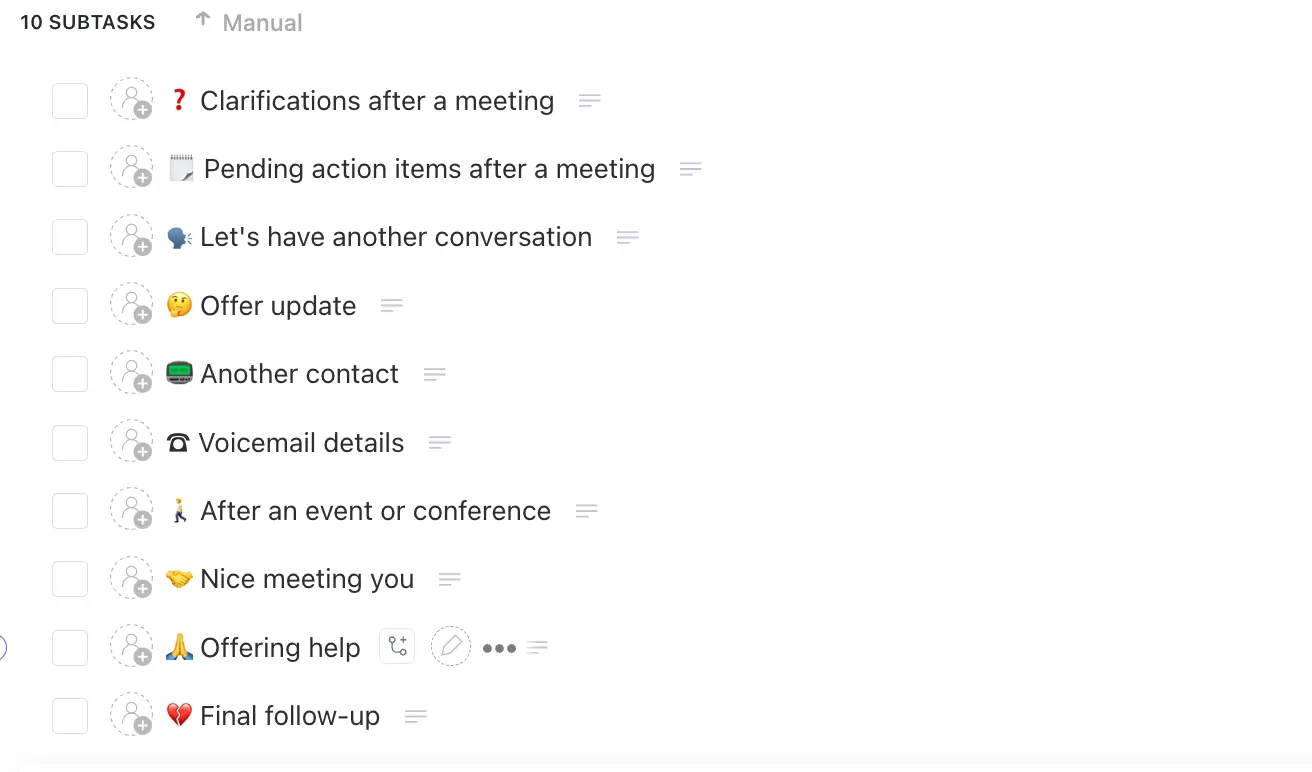
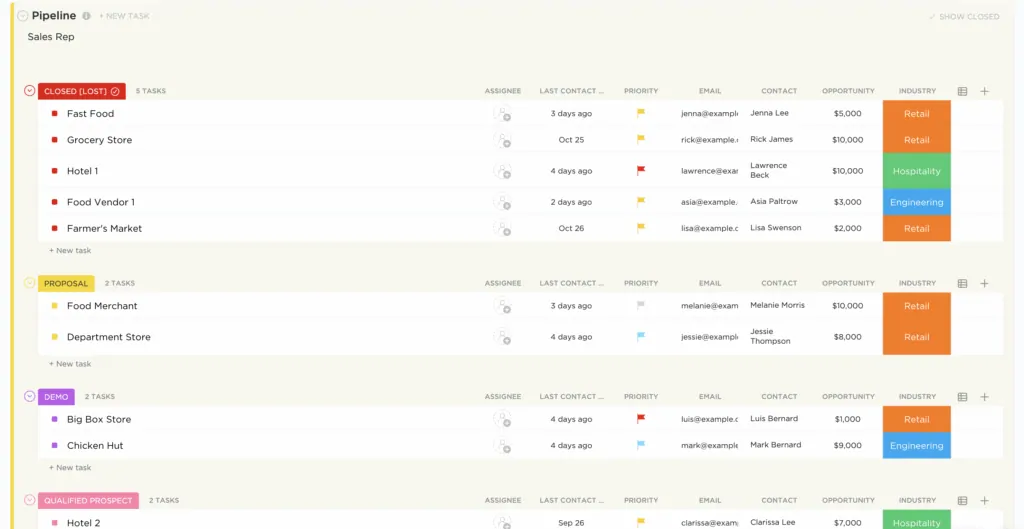
An example of tasks and subtasks that help you follow a lead, with reminders and details on each follow-up.
Many sales are lost because the salesperson did not follow up and the prospect chose someone who did.
You do not want to be pushy, but a friendly reminder is often welcome: busy prospects sometimes want you to remind them because they have a hundred other things on their mind.
Example:
You sent a proposal two weeks ago and have heard nothing.
A nurturing message:
"Hi [Name], I hope all is well. Last time you were planning the budget: how is it going? I thought this ROI calculator might be useful for [reference to the problem]. Let me know if you have any questions, happy to talk whenever suits you."
This message offers something useful (the ROI calculator) and gently reminds them of the proposal, without sounding desperate or making them feel guilty for not getting back to you.
By nurturing leads, you keep the pipeline alive.
Deals that would otherwise die stay in play until they are clearly won or lost, and even lost ones sometimes come back.
Remember:
In B2B, "not now" does not mean "never".
Nurturing is there to maximise the chances of a future yes.
Step 5. Closing deals and after-sales follow-up
This is every business owner's favourite stage: closing the sale.
Your qualification and nurturing have paid off: the prospect is seriously interested.
Now you need to turn that opportunity into a client.
This last step can actually be split in two: closing the deal and after-sales activity.
Closing (negotiation and agreement)
When you reach the proposal/negotiation stage, it is time to clear up the last doubts, negotiate terms and sign.
How to do it well:
- Tailor the proposal: avoid generic presentations. Use what you learnt during nurturing to highlight the specific results the client cares about
("Based on our conversations, this package will increase output by 15% in 6 months, solving the bottleneck you described.").
It shows you listened and are offering a solution built for them. - Offer options where you can: proposing two versions of the service (e.g. standard and premium) can move the negotiation forward.
The prospect feels they have a choice.
Make sure both are sustainable for you.
They will often pick one rather than say yes or no to a single offer. - Negotiate sensibly: be clear about what is non-negotiable and where you have room (perhaps you can extend payment terms or add a small bonus service, but you will not cut the price by 50%).
Focus on value and results rather than the last penny.
Focus on ROI: if your solution brings £100k of benefit, a £10k price is a good deal.
Listen to their concerns: sometimes the obstacle is something solvable (delivery times) rather than price. - "Assume" the close: when the deal is near, talk as if you were already partners.
For example, say:
"When we roll this out next month..."
This helps build confidence that the deal will happen.
When the prospect says "yes" (e.g. a signed contract), it is done. But remember that your pipeline does not end here.
After-sales stage
A big mistake is to treat a closed deal as the finish line and move on.
Closing a new client is actually the entry to the next stage, what we could call customer success and retention.
Especially for SMEs looking for long-term relationships and referrals, keeping clients engaged after the sale makes a real difference.
What to do after closing:
- Thank and reassure the new client: send a warm thank-you email, or even a handwritten note.
Confirm they have made a good choice and that you look forward to delivering results.
It reduces second thoughts. - Effective onboarding: where relevant, guide them through the first steps with your product or service.
Introduce the account manager or support contact who will deal with the client from now on.
Smooth onboarding confirms their choice and makes them more likely to renew and give good references. - Stay in touch (upsell and referrals): put a follow-up in your calendar one or two months after the start.
Check satisfaction and results.
A happy client may be open to an upsell (e.g. an additional service).
Even if they need nothing else, a satisfied client is often willing to recommend you, but you usually have to ask.
A sincere request such as:
"Do you know another company that could benefit from the solution we put in place for you?"
can generate new, high-trust leads.
- Record feedback in your CRM: deals closed as won should be marked as such, with notes on why they closed (e.g. "The client valued our fast support").
If closed as lost (they chose a competitor or decided not to buy), record the reason just as carefully.
This information is very useful for improving.
Every lost deal offers insight to refine your approach.
You can even set a reminder to contact lost prospects again after a few months; decisions get reversed and new needs arise, and this lets you turn a no into a future yes.
By closing deals and continuing to nurture those relationships, you feed the pipeline in a new way: through renewals, upsells and referrals.
It becomes a cycle in which today's client produces tomorrow's lead.
Extra best practices to strengthen your B2B pipeline
Beyond the main steps, here are some extra tips to help you manage your pipeline better.
- Stay organised with a CRM:
Even if you are just starting, use a simple CRM, or at least a structured spreadsheet, to track the pipeline.
A CRM shows the stages, sets reminders and keeps all information in one place.
Many CRMs and lead generation tools (HubSpot, Zoho) also have free versions that are ideal for getting started (even with no budget).
What matters is using it consistently, otherwise you will lose track of how your deals are progressing. - Align marketing and sales:
If you have someone on marketing (even an agency), make sure they work closely with sales.
Sales can tell marketing which leads were good, and marketing can focus effort on those sources.
You can also use this information in your content marketing strategy: case studies, white papers and other content can be based on the questions the sales team hears most often.
In a micro-business it may be enough for the CEO (marketing) and the salesperson (sales) to talk every week. - Focus on quality, not just quantity:
It is worth repeating that a pipeline full of "inactive" leads is confusing and wasteful.
Better a smaller pipeline full of prospects that really match your target profile.
Quality > Quantity.
Keep refining your ICP and do not be afraid to drop leads that do not fit. - Adopt omnichannel outreach:
Use a multichannel approach to engage prospects.
Emails, phone calls, LinkedIn messages and so on should be coordinated so the experience feels seamless. You might send an introductory email, then a few days later send a LinkedIn connection request that mentions the email, then call.
B2B deals often involve contact across several channels before anyone signs. - Measure pipeline KPIs:
Start tracking a few key indicators, for example:
- conversion rate by stage (if 50 leads enter "Qualified" and 10 become clients, your conversion rate is 20%),
- pipeline velocity (average time from first contact to close),
- pipeline coverage (whether you have enough deals to hit your target, e.g. 3x your quota).
Even a manual monthly count will do.
By measuring, you can spot problems and know where to act (e.g. "leads are moving forward, but deals sit too long at proposal stage: why?").
- Learn from every "no":
Politely ask for feedback when a prospect does not go ahead.
Every lost deal is a chance to learn.
Was it price, features, timing?
Sometimes you will get no answer, but often you will, and that feedback is valuable.
Asking and showing interest can also keep you in the prospect's mind for the future. - Use happy clients to grow:
Existing clients are an extension of the pipeline: treat them well and they will fill the top with referrals, renewals and new purchases.
Keep your promises and build your reputation.
Encourage satisfied clients to spread the word, perhaps with a referral scheme:
"Introduce us to another company and get 1 month of service free."
This way the pipeline feeds itself through your success stories.
Common mistakes to avoid when building a pipeline
Even experienced companies can trip up when managing a pipeline. Here are some mistakes to watch for (and avoid):
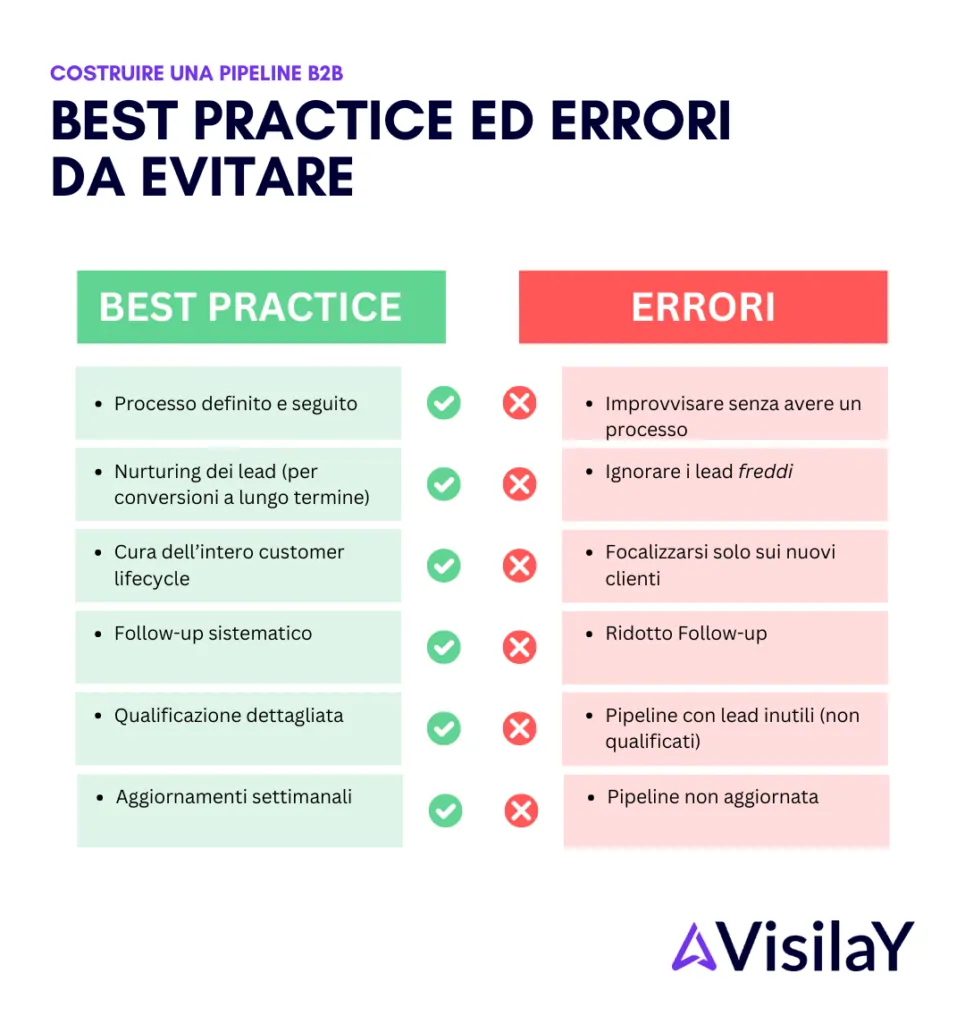
- "Winging it" without a defined process: handling leads in a disorganised way means missed follow-ups. Define your stages and sales process clearly from the start.
- Ignoring leads that are not ready now: not everyone buys straight away, but that does not make them useless. Do not remove leads who say "call me back in 6 months". Tag them as "future" and set suitable reminders.
- Focusing only on new leads and neglecting existing clients: the pipeline is not just about new business; it includes nurturing current accounts for loyalty and upsells.
- Weak follow-up: many salespeople give up after one or two attempts. Until a lead explicitly says "no", you can keep following up (usefully and without being pushy).
- Overloading the pipeline with unqualified leads: a pipeline full of "prospects" that are not really prospects gives false hope and wastes your time.
- Not updating the pipeline: your pipeline changes constantly, and if you do not update it, it becomes unreliable. Do it at least weekly to keep the data useful.
FAQ: frequently asked questions about building a B2B pipeline
It depends on the length of your sales cycle.
If it is short (a few weeks), you could close your first contracts a month or two after focused work.
For more complex B2B offers, it takes 3 to 6 months (or more) to go from first contact to signature.
The key is consistency: keep feeding and managing the pipeline and you will see a steady flow after the start-up period.
Many SMEs, with 6 months of work, manage to lay the foundations for steady monthly sales.
It depends on your conversion rate.
Put simply: you want 5 new clients a month and you close 1 deal for every 5 qualified leads?
You need about 25 qualified leads a month.
This relationship is called pipeline coverage.
Rule of thumb: 3x-5x coverage. If you want £10k in sales, keep £30-50k of deals in the pipeline.
You do not need expensive software at the start.
Many free CRMs (e.g. HubSpot) are enough for SMEs: you create deals, stages, tasks and emails in one place.
Trello or an Excel spreadsheet can also work.
What you need is a place for the information, a way to move deals between stages, and follow-up reminders.
The best tool is the one you will actually use.
Split the pipeline into smaller stages (e.g. "Under review", "Waiting for budget") to understand why a deal has stalled.
Keep nurturing while you wait, with relevant updates.
Set intermediate milestones and keep feeding the top of the pipeline to avoid lean periods.
Yes, especially so you do not miss upsell and cross-sell opportunities.
Track renewals too.
Many CRMs let you separate "New clients" from "Existing".
A pound from an existing client is worth as much as one from a new client, so it deserves its place in the pipeline.
Start building your B2B pipeline today, with Visilay
You now have a solid base and know where to start to build a B2B pipeline that supports your company's growth.
Starting from identifying the right leads, you can fill the pipeline, nurture prospects and get to the close, without skipping the after-sales stage. What counts is consistency and a clear plan.
If you are a small company or a micro-team, you may need specialist help to put effective strategies in place. At Visilay we work on B2B lead generation and can help you define your target, structure your pipeline (if you are just starting) or improve your current process (if you struggle to keep a steady flow of incoming leads).
